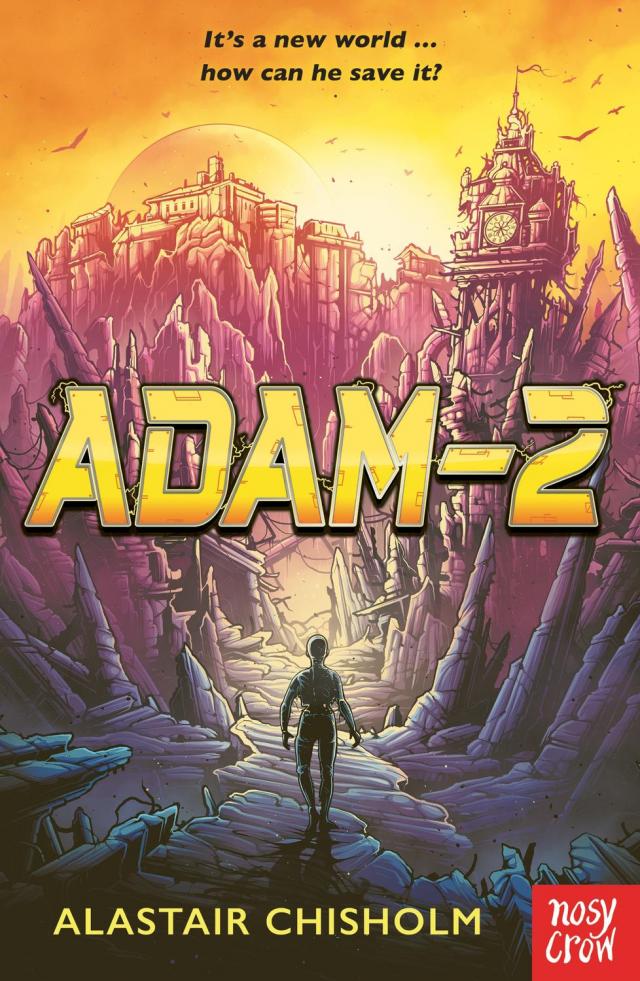
Adam 2, p.1
Adam-2, page 1


For Lois. Hello, sis!
A.C.
Adam
Adam woke up in the basement.
He lay in bed for a few seconds, blinking, then switched on his light and sat up. The basement was the same as always: quiet, tidy, with neat shelves of books and boxes, a table for working to one side. There were no windows, and the light hanging above him was harsh and white. Adam had hung coloured material and paper shapes around it to spread the light around the room and make it seem more like sunshine. The floor was concrete, and the walls. There was a door tucked in the corner, behind more boxes.
The alarm clock pinged, and he put out a hand to stop it. He sat for a few seconds, then swung his feet down to the floor, stood, and started his day.
Breakfast first, sitting at the little table. One table leg wobbled, and he frowned; he would need to repair it again. He sat over his plate and read a book, swinging his legs absently.
After breakfast, schoolwork. Adam cleared away the breakfast things and brought out a collection of ancient schoolbooks and jotters. The jotters were full of writing, down to the last corners of every page, smaller and smaller until he hadn’t been able to squeeze in any more. There was no more paper, and that had been a problem, but in the end he’d started again at the first page and carefully traced over the words already written. It didn’t really matter: his pencil had long since worn down to nothing, and now he only pretended to write, with a stick.
He read today’s sections in his schoolbooks and traced over the words in his jotter. He made a point of sticking his tongue out slightly as he wrote. At break-time he played by himself, practising juggling and keepy-up with small stones. He was very good; he could keep three stones in the air using just his feet. He knew he could probably do more but three seemed like the right number.
During break-time, something new happened.
A very slight tremor shook the basement, almost too faint to notice, as if something had clanged, quite far away. Adam looked up and watched tiny spirals of dust fall from the ceiling. He made a note of the time: eleven-oh-three plus seven point zero-eight-two seconds, although he knew the way to say this was “around eleven o’clock”. He waited for five minutes, but nothing else happened, so he returned to his work.
Then lunchtime, then speaking practice. At first it hadn’t occurred to him to do this, and he’d been alarmed one day to realise he might forget how to talk. Now he practised once every day. Since a new thing had happened today, he talked to himself about that.
“What could have caused a tremor like that?” he asked himself.
He paused. “Perhaps two things falling together. Rocks, or buildings,” he answered at last. “Nothing that affects me.”
“Perhaps I should go and investigate.”
This was an interesting idea. Adam considered it for a while.
“No,” he said, finally. “I should stay here, like Father said.”
He nodded. There. A conversation.
After speaking, playtime, with the toys. Not proper toys, of course, just things he’d found in the boxes on the shelves: pieces of old machinery, nuts and bolts; plastic and super-plastic shapes moulded to look like hip joints, or hands, or eyes; piles of ancient green circuit boards. He used them to make little models of cars, houses, people, and practised playing with them.
This was very difficult. He had to think about the people, and who they were, and what they would say. They didn’t live in a basement, of course, but that meant he didn’t really know what they did. He had to imagine things that weren’t real. It was the hardest part of his day, and exhausting, but he carried on dutifully for two hours, making up conversations they might have about things he couldn’t understand. Afterwards, he went back to bed for a rest.
Then chores: clearing the toys, sweeping up, checking the lights, carrying out repairs. He remembered where he had saved a tiny sliver of wood from the last pencil, and used it to stop the table wobbling, and felt pleased.
Then dinner time. For more speaking practice, he told the empty table about what he’d been doing, and how good he was getting at keepy-up, and how he’d fixed the wobbling table, and about the tremor that had happened at around eleven o’clock and had lasted for about five seconds. He smiled as he said it. It felt good to have something exciting to talk about.
Then he got ready for bed and laid out his storybook. The book was faded and very fragile, and he was careful not to tear its thin pages as he found his place. He laid it on the bed, open, and sat and listened as if someone were reading to him. Occasionally he smiled, or laughed, or frowned. After eight minutes and thirty-five seconds he sighed and closed the book.
“Goodnight,” he said.
There was no response.
“I love you too,” he said.
He turned to the wall behind his head and scratched a small, careful mark, and studied it for a few seconds. Then he switched off his light, closed his eyes and lay in the dark, listening to the tiny ping-ping-ping sound of the lamp as it cooled.
He slept.
Adam woke up in the basement.
He switched on his light and sat up; stopped the alarm when it rang, climbed out of bed, ate breakfast, did his schoolwork. At eleven-oh-three he looked up, wondering if there would be another tremor, but there wasn’t. Lunch, speaking practice, playtime – today he pretended the little people had felt a tremor, and were very excited – then rest, then chores, then bedtime. He opened his book carefully at the next chapter and listened as nobody read it. Then he said goodnight, told the empty basement that he loved it too, scratched a mark, closed his eyes, and slept.
Adam woke up in the basement. There was no tremor. He mended a small tear in the lampshade and talked about it at dinner time. In the evening, he laid out the next chapter of the book and listened. Scratched a mark. Closed his eyes. Slept.
Adam woke up in the basement—
Something was different.
He lay, quietly blinking in the dark. It wasn’t time for getting up yet, but he was awake because he had heard something. Something had woken him up. A banging noise, perhaps twenty metres away, seeming to come from somewhere out beyond the door. Banging, something breaking, and then a shuffling sound, coming nearer.
What should he do? Should he turn the light on? He wasn’t sure. The light was for morning. He left it off and listened. The sound was just beyond the doorway now. Two sounds, he thought, distinct, little flutters of something, like, like…
Speaking. It was two people speaking to each other. Adam tried to process this but instead found himself blinking again and again, apparently without his control. He sat up and waited.
There was a scratch at the door. The voices were right outside. Then a movement; he could see the door trembling. A metallic click, and the door opened. Just a crack; just until it pushed against a box piled against it. Light moved from behind it, two thin lances of light. The voices muttered again. “Stuck,” one of them said.
Then the door shuddered open, pushing the box out of the way, and two figures followed it. They pointed their lights around, but not at Adam, at first. He sat still and watched them in astonishment.
They were young. One was only twelve perhaps, the other a bit older. They wore clothes he didn’t recognise, a mix of different colours patched together. Some of the material was plastic, some fur, and all battered and torn. The older one was taller, and moved more cautiously. The shorter figure’s right hand glinted and Adam realised it was prosthetic, made of plastic and metal.
“Whoa,” said the shorter one, pointing at shelves of machine parts. The light came from the artificial hand, Adam realised; it must have a torch built into it. “Look at this stash!”
“What about batteries?” muttered the other. This one’s voice was deeper, and more wary.
“Nothing yet. Hey, look!”
The torch played over the table in the corner where Adam had set out tomorrow’s breakfast plates.
“What the hell?” The shorter one walked to the table and touched the plates. “This is weird. It’s like someone was playing…” Then silence. Then: “Linden, look.”
“What?”
“There’s no dust on the plates.”
The taller one, Linden, stopped looking and turned. “What?”
“There’s no…” The shorter one swung her torch-hand around to point at the shelves and boxes. “It’s weird. There’s no dust anywhere. It’s like—” Then, in a gasp: “Someone’s cleaned this room! Linden, someone’s been here!”
The one called Linden stepped across quickly. “Don’t move, Runa! Don’t go any further!” Torchlight flickered over the table, the walls, the shelves …
… and over Adam, sitting in bed.
“Hello,” said Adam.
“Aargh!”
“Run!” They crashed back towards the door. “Move! Runa, move!”
Adam stared after them. This was all very confusing. He tried to think what to say, but he wasn’t sure what the situation was. Were they guests? That didn’t seem right.
“Here’s the door, go, go!”
“Stop!” he tried. “Hello?”
The taller one held the door open. The younger one, Runa, started through, then stopped. The torch-hand pointed back over Adam.
“What is it?”
“Who cares? Go!”
But Runa hesitated, then stepped carefully towards Adam, slipping away from the other’s grasp.
“Runa, come back!”
Torchlight shone again over Adam’s face.
“Look at it.”
“I can see it!”
“Did it just speak to us? Was it talking?”
“Yes,” said Adam. “Hello.”
“Aargh! Runa, come on!”
But Runa still didn’t move.
“My name is Adam,” said Adam. “Are you friends of Father?”
“Oh, wow.” Runa’s voice sounded scared, but also surprised. “Can you understand us?”
“Yes,” said Adam. “You are Runa. Your friend is Linden. I am Adam.”
Runa laughed suddenly. “Oh, wow. Linden, look at this! Look at it!”
Linden hesitated at the door, then cursed and came back. “I see it.” Torchlight shone straight into Adam’s eyes. “I see it.”
“What do you think it is?” asked Runa.
“You know what it is,” growled Linden. “It’s dangerous. It’s tin. It’s a Funk.”
They moved closer, keeping their torches on Adam until they were only a few centimetres away from his face.
“It’s a robot.”
“Hello,” tried Adam again.
Linden
“I don’t think it’s a Funk,” said Runa, peering at it. “It’s got a face, look.”
Linden scowled. It was true; the thing had eyes like models of human ones, with fake irises that contracted in the torchlight, and a mouth with white plastic teeth and metal lips. Just a slight bump for a nose, and microphones for ears; it looked like a metal and plastic skull. The eyes shone white and blue, and had weird fake eyebrows.
It was incredibly creepy. The sides of its lips were lifted as if it was pretending to smile. It made Linden’s skin crawl.
“Don’t get so close,” growled Linden.
Runa tapped its forehead, and the fake eyelids flicked. The finger of her prosthetic hand made a dink sound.
“Hello,” the thing said again. Its voice was creepy, too – almost human, a little scratchy, but like a human boy. It was very calm. With a shudder, Linden realised it even had a fake tongue.
“Leave it, Runa.”
But Runa didn’t move. “I don’t think it’s a Funk,” she said again. Her face was fixed into the stubborn, fascinated expression that Linden recognised and dreaded. Carefully, trying not to be too obvious, Linden reached into a back pocket and took hold of their one working EMP stick.
The thing’s body was pale white plastic, with dull metal “bones” peeking out as if from a half-decayed corpse. It was smaller than Runa, but its metal legs and arms seemed powerful and dangerous.
“What are you, little thing?” asked Runa.
“I am Adam version two point zero, a prototype experimental artificial entity.” One arm lifted, and Linden stiffened, but its hand only reached out as if waiting to shake.
“Runa—” warned Linden.
Runa laughed and shook the hand. “Hello, Adam. I’m Runa.”
“Yes,” it said. “You are Runa. You are a human female.” It turned towards Linden. “You are Linden. You are a human female—”
“No I’m not,” snapped Linden.
The machine’s eyes moved horribly, blinking. “Your bone structure suggests—”
“Linden’s non-binary,” said Runa. “NB, enby, yes? No defined gender. Do you know what that means?”
“Of course,” it said. “Linden is neither male nor female.” It turned towards Linden and its eyes seemed to roll, white and stark inside its sockets. “Which pronouns would you prefer me to use?”
Linden glowered, but Runa said, “Ze instead of he or she, and hir instead of his or her.”
“Of course,” it said again.
“Enough,” said Linden. “Right, you’ve had a look, now we go, Runa. There’s no food here, OK? Just this … thing.”
“What is a Funk?” it asked.
“A machine with Functional Consciousness,” said Runa. “A thinking machine. A robot.”
“Ah,” said the thing. It paused. “Yes. I am a Funk.”
Linden swung hir EMP stick around, jammed it against the plastic face and pulled the trigger.
Runa leaped back with a shout. The thing shrieked, high and piercing, and its teeth clamped together, blue sparks firing up around its skull and body.
“Eeeeeeeeeeeee—” it screamed, then stopped dead. A faint trail of smoke spiralled out lazily from its mouth, and there was a sudden sharp smell of burning plastic.
Runa gasped. “Linden! What have you done? You broke it!”
“You heard what it said!” snapped Linden. “It was a Funk. Now come on – we’ve got to get out of here before its friends arrive!”
The thing slumped to one side and smacked against a clock on a table next to it, smashing it into pieces of ancient, brittle plastic.
“It wasn’t anything like the Funks!” shouted Runa. “It was something else, and we could have used it!” She peered down at it. “It must have had power,” she said, suddenly, and tapped the metal platform underneath it. “This is a charging station.”
“So what? Come on!”
But Runa still had that face on, and she ignored Linden. “There’s a switch here,” she muttered. She clicked it.
Lights came on in the room, and Runa and Linden stared.
The light had an odd colour, not white. A strange plastic shade over the lamp created orange patches and weird shadows. In the light, they could see the wall behind the thing. It was covered in scratches.
It was covered in scratches.
Thousands… Tens of thousands of them. Every fifth scratch formed a line through the previous four.
“Did it make these?” muttered Runa. “How long has it been here?”
Linden glanced around. There was the table, laid with a chipped bowl and plate, and a spoon. Shelves against one wall held ancient and decaying boxes, and a few books. There was some sort of repair system in the corner.
“I don’t know,” ze said. “Runa, we’re getting out of here now, understand?”
The thing screamed. “Eeeeeeeee!”
“Argh!” Runa and Linden jumped away. Lights came on in the back of the robot’s neck, and it raised itself back into a sitting position.
“Eeeeeeeee!”
“Run!”
“Eeeeeeee-hello, my name is Adam. Please wait. Hello.”
They stopped again at the door and stared back. The thing looked at them. “Hello, Runa. Hello, Linden. I’m sorry; I have experienced a temporary system error. I believe it was when you touched me with that device. What was it?”
Runa and Linden gaped at him.
“E … EMP stick,” said Runa at last. “Electromagnetic Pulse. It, ah, disrupts your electrical systems and neural paths.”
“Ah,” said the thing. It moved its head from side to side, as if considering this.
“It should have killed you,” said Runa, faintly.
The thing blinked. “Ah.”
It stood up. Linden cursed; that was their only EMP stick. Could they outrun it? But you couldn’t outrun Funks. Hir heart thumped. Oh, no, oh, no, oh, no.
It didn’t move towards them. It seemed to be thinking.
“I’m sorry,” it said at last. “I believe I have made a bad first impression.”
Runa and Linden stared at it. There was a long pause, and eventually Runa pointed at the wall.
“Those scratches,” she said. “Did you make them?”
“Yes.”
“Why?”
Its head swung to look at the wall and back. “I don’t know.” It seemed slightly surprised.
“How long… How long have you been here?”
The machine’s lips curled up into another grotesque smile.
“Two hundred and forty-three years, eight months, six days, nine hours and fifty-one minutes,” it said.
Linden’s mouth fell open.
“No way,” gasped Runa.
Its eyebrows lifted. “Yes … way?” it said.
*
Runa’s logic was maddening. “Look, if it wanted to kill us, it could, right? We can’t run fast enough, and you used up our EMP stick.”
“I do not want to kill you,” said the machine.
“Shut up,” said Linden.
“This thing is older than the war,” said Runa. “I think it’s older than the Funks. I bet it knows useful stuff!”
“Like what?”
“Like … things lost in the war. Maybe old maps. Maybe power supplies. And it survived an EMP blast – that’s pretty impressive, right?”