The human kind, p.1
The Human Kind, page 1


PRAISE FOR IMPERIAL WAR MUSEUM WARTIME CLASSICS
‘If poetry was the supreme literary form of the First World War then, as if in riposte, in the Second World War, the English novel came of age. This wonderful series is an exemplary reminder of that fact. Great novels were written about the Second World War and we should not forget them.’
WILLIAM BOYD
‘It’s wonderful to see these four books given a new lease of life because all of them are classic novels from the Second World War written by those who were there, experienced the fear, anguish, pain and excitement first-hand and whose writings really do shine an incredibly vivid light onto what it was like to live and fight through that terrible conflict.’
JAMES HOLLAND, Historian, author and TV presenter
‘The Imperial War Museum has performed a valuable public service by reissuing these four absolutely superb novels covering four very different aspects of the Second World War. I defy you to choose which is best: I keep changing my mind!’
ANDREW ROBERTS, author of Churchill: Walking with Destiny
PRAISE FOR THE HUMAN KIND
‘Extraordinary... bears remarkable witness to the Second World War’
WILLIAM BOYD
‘An unqualified masterpiece’
Guardian
THE HUMAN KIND
Alexander Baron
First published in Great Britain
by Jonathan Cape Ltd 1953
First published in this format in 2024 by
IWM, Lambeth Road, London SE1 6HZ
iwm.org.uk
© The Estate of Alexander Baron, 2024
About the Author and Introduction
© The Trustees of the Imperial War Museum, 2024
All rights reserved. No part of this publication may be reproduced, stored in a retrieval system or transmitted, in any form or by any means, electronic, mechanical, photocopying, recording or otherwise without the prior permission of the copyright holder and publisher.
ISBN 978-1-912423-79-8
ePub ISBN 978 1 91242 386 6
Mobi ISBN 978 1 91242 386 6
A catalogue record for this book is available from the British Library.
Every effort has been made to contact all copyright holders.
The publishers will be glad to make good in future editions any error or omissions brought to their attention.
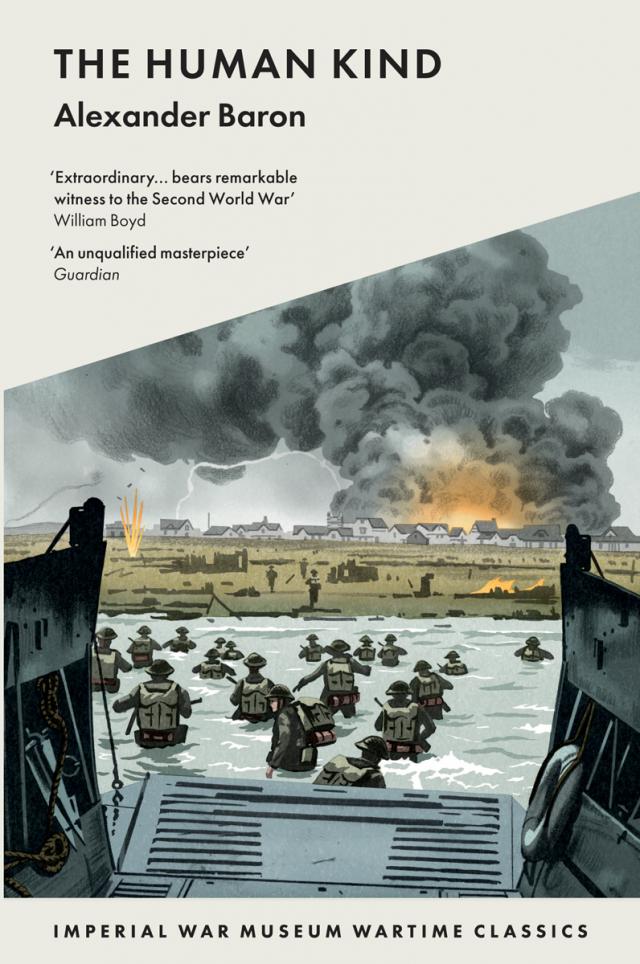
Cover illustration by Bill Bragg
Design by Clare Skeats
Series Editor Madeleine James
About the Author
Alexander Baron (1917–1999)
ALEXANDER BARON was born on 4 December 1917. He grew up in Hackney, East London, and became active in the 1930s in left-wing politics and the anti-fascist movement. During the Second World War he served with the Pioneer Corps in Sicily, Italy and northern France, basing his first novel, From the City, From the Plough on his experiences of the D-Day landings and the allied advance into Normandy. The novel was both a critical and popular success, establishing Baron’s reputation as a skilled, powerful and authentic writer. It was praised by V.S. Pritchett as ‘The only war book that has conveyed any sense of reality to me’. Other reviewers wrote: ‘every reader who fought in Europe will acclaim this story as the real thing’ and ‘we have waited a long time for this war’s All Quiet on the Western Front. Here it is’.
Baron went on to publish fifteen novels in all, including two more based on his wartime experiences: There’s No Home (1950), set during the Italian campaign, and The Human Kind (1953, later filmed by Carl Foreman as The Victors, 1963). Eight of Baron’s novels, including the ‘War Trilogy’, are currently in print. He also wrote numerous film and television screenplays. He died in 1999.
Introduction
First published in 1953, The Human Kind is the concluding volume of Alexander Baron’s ‘War Trilogy’, alongside From The City, From The Plough (1948) and There’s No Home (1950), both of which are also available in the IWM Wartime Classics series. These last two titles are novels dealing with specific wartime events in which Baron participated – the 1944 Normandy landings, and the campaign in Sicily in 1943. The Human Kind is, on the face of it, a very different kind of book, a series of short stories each of which could be read in isolation, and each of which seemingly has its own particular focus and ‘message’. However, all of the stories have a narrator in common, although he is largely unidentified except for an almost casual reference towards the very end of the book, when a character introduces him to another as ‘Alex’. To those already familiar with his voice, the narrator is very clearly Alexander Baron, and the stories he tells in his distinctive way are linked by the common threads of his own lived experiences.
As the reader progresses through the book, it quickly becomes rather less of a collection of short stories and more like a memoir, with a clear chronological direction. The first story, titled ‘Strangers to Death: A Prologue’, appears to have very little to do with war at all, concerning as it does the narrator’s boyhood enthusiasm for cycling and a trip to the countryside with friends. In fact it very much sets the scene for what follows and is not just a tale of carefree childhood pursuits in the innocent days before the Second World War. Early in the story, a boy drowns while swimming in a river, the narrator’s first experience of death – but one that has a sense of unreality. The humble bicycle later becomes a machine of alarming speed and ever-present danger to its rider, with the potential to terminate life suddenly and shockingly. The narrator is thrown from his mount into the path of a bus, escaping serious injury or death by a hair’s breadth, yet his overriding feeling is one of exhilaration: ‘I was an aviator, riding in one of the echelons of his squadron. I was a cavalryman in the ranks of his thundering troop.’ Survival of danger and death confers upon the survivor a heroic quality, he realises ‘with joy’ that he has become ‘a person of importance.’ The story ends with the line: ‘Life was inexhaustible and death was still beyond our ken’.
The four stories that follow this prologue reflect various episodes and observations from Baron’s home service with the Pioneer Corps during the early years of the Second World War. ‘The Sentry’ continues the theme of youthful innocence as yet untested by the horrors of war in the summer of 1940, when even the first air raids and the Dunkirk evacuations could not shatter the overriding mood of what Baron calls ‘fascinated incredulity’. Subsequent stories tell of the sudden and unexpected enthusiasm of his comrades – ‘a tough, turbulent crowd’ of Londoners – for the novels of Charles Dickens (‘Copperfield and the ‵Erbs’), the pathos and casual cruelty of sexual encounters between soldiers and civilians (‘The Hunchback Woman’), and his experience of working with a group of miners during the construction of an underground military headquarters (‘The White Domain’). This latter story speaks powerfully of Baron’s empathy with and understanding of the hidden lives of ordinary workers, which drove his youthful political radicalism in the 1930s. Whilst framed in terms that modern readers may well find offensive but which at the time were quite normal, ‘The Hunchback Woman’ reveals the author’s concern for the marginalised and disregarded in society, and the sexual exploitation of women.
The stories that occupy the middle section of the book echo themes and characters which Baron developed in There’s No Home, based on his experiences during the Allied campaign in Sicily in 1943. In ‘Old Beethoven’, Baron describes a significant aspect of the Sicily campaign that is almost completely absent from the narrative of the earlier book – the initial amphibious landings and the subsequent brutal fight for the island. His personal experience informs the stark setting of this story: ‘The sweet stench of unburied dead, men and beasts, hung upon the air. The white dust drifted and tormented. There were mosquitoes and malaria. The Germans had their snipers everywhere, and it was dangerous to show ourselves above ground by daylight. We huddled, ill and miserable, in our burning little holes in the ground.’ For a moment we are there with Baron in this hellish landscape of death, and can almost hear the crack of the German sniper’s rifle as it suddenly and mercilessly extinguishes the ardent young life of one of his trench companions. ‘Chicolino’ also picks up on a subject from the earlier novel – the sexual exploitation of local children by the Allied soldiers and the trading of sex for money and food. In this story it is a young boy (in There’s No Home it is a girl) who has been forced into adulthood before their time, although in Chicolino’s case the soldiers he approaches try to return him to his home rather than take advantage of him. And one story, ‘The Indian’, relates directly to a key moment in There’s No Home, when Sergeant Craddock and local woman Graziella first become lovers. Baron tells us what really happened to bring the two together, involving the sudden appearance of an Indian soldier on a street in Catania. We learn that Indians (unlike Black American troops) were unaccountably viewed with fear and suspicion by the locals, particularly in this case, when the soldier is drunk.
With one of the longer stories in the book, ‘Mrs Grocock’s Boy’, we transition from Sicily and Italy to the D-Day landings and Normandy campaign of 1944, likewise reflecting Baron’s own Pioneer Corps service. Readers of From The City, From The Plough will be strongly reminded of scenes and personalities in that novel. Baron’s faultless grasp of the psychology of soldiering is evident in this story about a simple home boy, a ‘child in a man’s body’, cruelly pitched into the inferno of war. His comrades do their best to look out for him, humour him, shield him from the worst, treating him like a human regimental mascot. But in this they are blind to his own experience
Normandy is also the setting for the next three stories, well observed vignettes during the British advance from the beachhead inland. A tank stops at an abandoned house to load up a piano (‘Daisy May’s Crew’), a local Norman woman is unofficially and against military regulations adopted as a bedfellow and housekeeper for some of the soldiers (‘Mélanie’), and Baron himself has a brief and dream-like encounter with another woman left behind by the war (‘Being and Non-Being’). It is an opportunity for him to reflect on the impact the war has had on him: ‘Four years of my life had already drained away in uniform. Content to live physically active and intellectually lethargic [...] enclosed in a womblike warmth of comradeship, literally unaware of past or future, I had let every thread of connexion with my old life snap.’ It is a theme reiterated elsewhere in Baron’s work, including There’s No Home – the enclosed and disconnected world of the soldier, sustained in the here and now only by the community of his company or platoon.
With ‘A Pal’s a Pal’, we move from Normandy to Belgium and the final months of the war. In this and the following story (‘The Venus Bar’) relationships between occupying soldiers and local inhabitants, particularly women, are further explored, in that strange place in which the fighting has moved on and a ghostly semblance of peacetime re-emerges. We enter the murky undergrowth that war particularly nourishes: ‘In silent streets, behind the shuttered doors of inconspicuous houses, a whole world of illicit occupations flourished: brothels, drinking-dens, black-market restaurants, gambling houses, lodgings for deserters’. In ‘The Venus Bar’, Frank Chase (possibly another version of Baron himself) almost gets swallowed up by this underworld, a veritable Venus flytrap for the unwary soldier.
Frank Chase reappears in ‘Victory Night’, set at a time when the end of the war in Europe is imminent, ‘petering out in a remote, nightmarish way that none of us had foreseen in our daydreams’. Burnt out by almost five years of war, Chase is sent home to recuperate, very much like Raymond Grocock: ‘We congratulated him on his good fortune, but our well-meaning remarks only drew from him smouldering, disbelieving looks. In his own mind, he had failed.’ Sent to a psychiatric hospital following a nervous collapse (suffered, ironically, during VE Day celebrations), Chase meets other soldiers who have had ‘secret wounds’ inflicted on them by their war experiences. This helps him to re-evaluate his own outlook on life and discard many of the intellectual crutches he propped himself up on before the war. Rather than representing a disintegration of his life, Frank’s breakdown is in fact ‘a maturing, as messy and painful as a childbirth: the birth, that every man had to go through, of his post-war self’. In ‘The Way a War Ends’, Baron takes leave of the dream of Soviet troops – ‘Joe’s boys’ – bringing Communist fraternity and a better world with them as they enter a defeated Nazi Germany. In the words of a disillusioned British soldier in Berlin who had previously shared this vision: ‘They won’t be satisfied till they’ve conquered us, too’. The result is a Russian corpse at the bottom of the Spandau Canal, put there by the British soldier’s knife.
The book ends with an Epilogue story set, unexpectedly and at first sight incongruously, in Korea during the 1950-53 War there. Two American soldiers at an open-air film show for the troops are on the point of shooting what they take to be a Korean sniper hidden in a tree – a ‘gook’, a ‘little brown bastard’. But something stops them from doing so as they realise he is just watching the film too, with an innocent enjoyment. As one of them observes in the penultimate line, ‘Ya’d think the guy was human!’ This, in its own quirky way, encapsulates a central theme of Baron’s writing about war, any war (the fighting in Korea ended in the year The Human Kind was first published): it is about being human in all its manifestations, its complexity and simplicity, its darkness and light, its sublime highs and pathetic lows, and all shades in between. Above all, Baron writes about ordinary people he knew and understood, and makes us know and understand them too. We are richer for the experience.
Not long before he died, Baron wrote that his ‘War Trilogy’ was strictly speaking not such at all, ‘but a sequence of works exploring the theme of people living in a world at war’. He did, however, view them as ‘a single body of work’, which he hoped might one day be published together, ‘preferably linked by a master title (Men, Women and War has been suggested)’. It is hoped that their publication in the present IWM Wartime Classics series goes at least some way towards fulfilling Baron’s wishes and maintaining his literary legacy as one of the foremost writers about the Second World War.
Stephen Walton
2024
Contents
STRANGERS TO DEATH: A PROLOGUE
THE SENTRY
COPPERFIELD AND THE 'ERBS
THE HUNCHBACK WOMAN
THE WHITE DOMAIN
OLD BEETHOVEN
THE PILLBOX
THE MUSIC BOX
THE DEAD CART
CHICOLINO
THE DESERT MOUSE
THE INDIAN
MRS GROCOCK’S BOY
DAISY MAY’S CREW
MÉLANIE
BEING AND NON-BEING
A PAL’S A PAL
THE VENUS BAR
EFFICIENCY
EVERYBODY LOVES A DOG
VICTORY NIGHT
MANNERS MAYKETH MAN
SCUM OF THE EARTH
THE WAY A WAR ENDS
THE HUMAN KIND: AN EPILOGUE
STRANGERS TO DEATH: A PROLOGUE
WHEN I WAS sixteen my parents bought me a bicycle. It was a sports model, with cream mudguards and handlebars, light blue frame and chromed fittings: the most beautiful work of art I had yet encountered.
I had been worshipping it for weeks in its shop window, and pleading with my parents for it. They had resisted, not because it was expensive but because it was dangerous. They had weakened, and offered to buy me a cheap, safe machine. Then they had come with me to the shop, seen me looking at the ‘Silver Wing’ and – as working-people generally do for their children – they had bought it for me.
I had never ridden a full-size bicycle before. The older boys in the street, owners of machines even more graceful and expensive than mine, would not take the risk of giving rides to a beginner. I brought my ‘Silver Wing’ home on a Friday, promised my parents that I would not go out of the street with it until I was sufficiently practised, spent the evening wobbling round and round the block on it – and the next morning I set off on a weekend trip.
Every Saturday morning from early spring to late autumn, a crowd of young people would meet at the street corner. The cyclists, with rucksacks on their backs, tin mugs and kettles, all a-rattle, tied with string to their crossbars, and cheap little tents slung under the saddles, would stream away along the Cambridge road to their camping-site by the River Lea. Others would follow by bus.
On Saturday morning, then, I carried my bicycle down the front steps into the lovely May sunshine with happiness racing inside me, and a rucksack and brew-kettle on my back, and joined the group at the street corner.
This was a rash thing to do, for the weekly swoop out of town was led by a group of veterans who set a furious pace, heading a follow-my-leader at top speed in and out of the traffic that was beyond the skill of a beginner.