Black oak 3, p.1
Black Oak 3, page 1
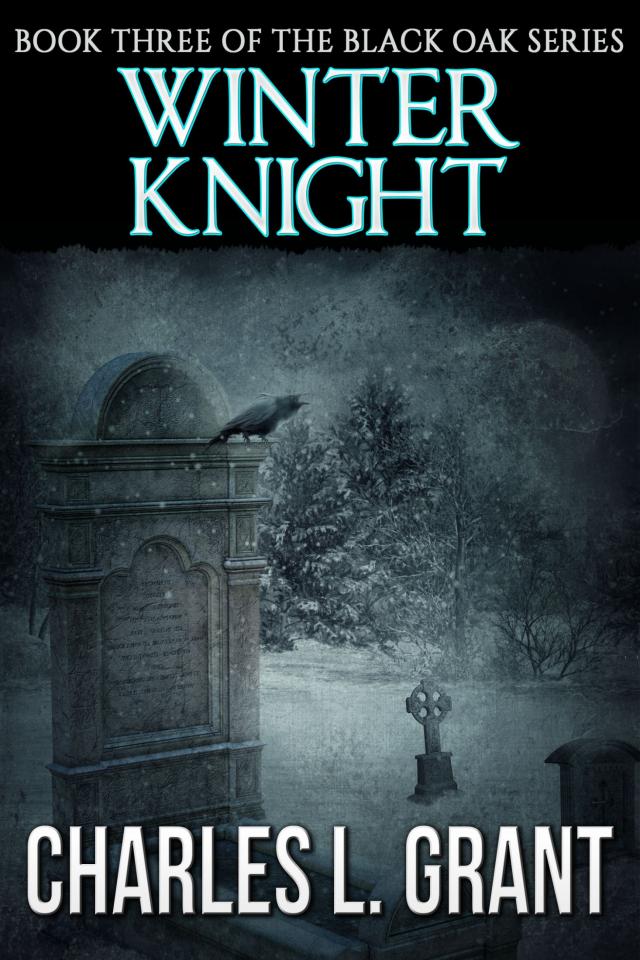


BLACK OAK #3: WINTER KNIGHT
By Charles L. Grant
A Macabre Ink Production
Macabre Ink is an imprint of Crossroad Press
Digital Edition published by Crossroad Press
Smashwords edition published at Smashwords by Crossroad Press
Digital Edition Copyright 2016 Kathryn Ptacek
Copy-edited by: Duncan Douglas
LICENSE NOTES
This eBook is licensed for your personal enjoyment only. This eBook may not be re-sold or given away to other people. If you would like to share this book with another person, please purchase an additional copy for each person you share it with. If you’re reading this book and did not purchase it, or it was not purchased for your use only, then you should return to the vendor of your choice and purchase your own copy. Thank you for respecting the hard work of this author.
Meet the Author
Photo by Jeff Schalles
Charles L. Grant taught English and history at the high school level before becoming a full-time writer in the ’70s. He served for many years as an officer in the Horror Writers Association and in Science Fiction Writers of America.
He was known for his “quiet horror” and for editing the award-winning Shadows anthologies. He received the British Fantasy Society’s Special Award in 1987 for life achievement; in 2000, he was the recipient of the Lifetime Achievement Award from HWA. Other awards include two Nebula Awards and three World Fantasy Awards for writing and editing.
Charlie died from a lengthy illness on September 15, 2006, just three days after his birthday. He lived in Newton, NJ, and was married to writer/editor Kathryn Ptacek for nearly twenty-five years.
Book List
Horror
Novels
Black Oak: Genesis
Black Oak: The Hush of Dark Wings
Black Oak: Winter Knight
Black Oak: Hunting Ground
Black Oak: When the Cold Wind Blows
Fire Mask
For Fear of the Night
In A Dark Dream
Jackals
Millennium Quartet #1: Symphony
Millennium Quartet #2: In the Mood
Millennium Quartet #3: Chariot
Millennium Quartet #4: Riders in the Sky
Night Songs
Raven
Something Stirs
Stunts
The Bloodwind
The Curse
The Grave
The Hour of the Oxrun Dead
The Last Call of Mourning
The Nestling
The Pet
The Sound Of Midnight
The Tea Party
The Universe of Horror Trilogy
The Soft Whisper of the Dead
The Dark Cry of the Moon
The Long Night of the Grave
Collections
Dialing the Wind
Nightmare Seasons
The Black Carousel
The Orchard
Science Fiction
A Quiet Night of Fear
Ascension
Legion
Ravens of the Moon
The Shadow of Alpha
As “Geoffrey Marsh”
The Fangs of the Hooded Demon
The King of Satan’s Eyes
The Patch of the Odin Soldier
The Tail of the Arabian, Knight
As “Lionel Fenn”
The Quest for the White Duck Trilogy
Blood River Down
Web of Defeat
Agnes Day
668, the Neighbor of the Beast
By The Time I Get To Nashville
Mark of the Moderately Vicious Vampire
Once Upon a Time in the East
The Once and Future Thing
The Really Ugly Thing From Mars
The Reasonably Invisible Man
The Seven Spears of the W’dch’ck
Time, the Semi-Final Frontier
As “Simon Lake”
Daughter of Darkness
Death Cycle
Death Scream
He Told Me To
Shapes Berkley
Something’s Watching
The Clown
The Forever House
As “Felicia Andrews”
Moonwitch
Mountainwitch
Riverrun
Riverwitch
Seacliffe
Silver Huntress
The Velvet Hart
As “Deborah Lewis”
Eve of the Hound
Kirkwood Fires
The Wind at Winter’s End
Voices Out of Time
DISCOVER CROSSROAD PRESS
Visit us online
Check out our blog and
Subscribe to our Newsletter for the latest Crossroad Press News
Find and follow us on Facebook
Join our group at Goodreads
We hope you enjoy this eBook and will seek out other books published by Crossroad Press. We strive to make our eBooks as free of errors as possible, but on occasion some make it into the final product. If you spot any problems, please contact us at publisher@crossroadpress.com and notify us of what you found. We’ll make the necessary corrections and republish the book. We’ll also ensure you get the updated version of the eBook.
If you’d like to be notified of new Crossroad Press titles when they are published, please send an email to publisher@crossroadpress.com and ask to be added to our mailing list.
If you have a moment, the author would appreciate you taking the time to leave a review for this book at whatever retailer’s site you purchased it from.
Thank you for your assistance and your support of the authors published by Crossroad Press.
BLACK OAK #3: WINTER KNIGHT
Previously, in Black Oak
Ethan Proctor, to a young woman who walks with him in a lonely town in Kansas: “Do you believe in ghosts?”
“It’s very simple,” says Taylor Blaine. “I want you, and Black Oak, to find my daughter. She’s been missing thirteen years, but I know she’s still alive. I don’t care what you have to do, who you have to see, how much money you have to spend, how many enemies you make … I have contacts, Proctor, I have all the money you’ll ever need.
“Find her. That’s all I ask. Just find her.”
In Atlantic City, a man named Shake Waldman is gunned down in the street. He’s a small-time gambler, Waldman is, and a source of occasional information for Black Oak and Proctor. As he lies dying on the sidewalk, rain falling into his eyes, he sees the man who killed him, standing over him and smiling.
It’s difficult to breathe, worse to think, but there’s something wrong with his assassin, and in the time between the smile and the dying, he understands what it is—the man has one glass eye, and it looks just like a marble Waldman had as a kid.
Tiger’s eye; it looks just like a tiger’s eye.
Ellen Proctor sits by a window in a nursing home she’s lived in for almost seven years. Her hair is brushed, her clothes are clean, her hands lie calmly in her lap. Her face is turned slightly toward the winter sun, but there is no smile at her mouth, no smile in her eyes.
When it’s time for meals, a nurse feeds her; when it’s time for bed, a nurse helps her; when it’s time to wash, a nurse bathes her.
Physically she is as healthy as she can be in such a situation.
Proctor visits her every Wednesday night, and every Wednesday night he tries to bring her back. No one knows where she is or why she’s there, but Proctor tries to bring her back.
She hasn’t said a word in almost seven years.
do you believe in ghosts ?
ONE
Night in early January, the first Sunday, and a silence that belongs only to winter, a darkness without the moon.
The shops were closed along Battle Row, the display windows dark, no need for night-lights or spotlights or alarms.
A few of the buildings were mock Tudor, first floors extending partway over the large-block pavement on either side of the street, with heavy casement windows and mullion panes, and window boxes now empty, not to be seeded until spring; the rest were ordinary brick and weathered stone, tonight made extraordinary by the sharp brittle air that sparkled around the streetlamps, and by the snow that fell slowly out of the dark.
At the top of the Row was the Raven’s Loft, another Tudor but not a copy; two years before it had celebrated its three hundredth birthday. It too went dark once the land-lord, Darve Westrum, ushered Conrad Cheswick politely out the door and politely, but firmly, closed it behind him.
Conrad stood in the cold then, shivering as he buttoned his topcoat and adjusted his scarf more snugly around his neck. A rotund man with a close-cropped white beard and thick white hair, round cheeks and bright eyes, he resembled to his constant discomfort a cartoon rendering of Father Christmas in tailored cashmere. It especially bothered him this time of year, although Christmas and Boxing Day were a long fortnight gone.
Briskly he rubbed his gloved palms together and blew out a puff of breath, watched it expand and fade, and reckoned it was time he made his way home. Not at all drunk, but not completely sober either. A good thing, he thought, that he hadn’t driven. He had a feeling as he took his first step away from the pub that he’d probably end up in a ditch somewhere and never hear the end of it.
He also wished he had worn his cap. The snow had already begun to catch and melt in his thick wavy hair, and by the time he reached his hearth he’d no doubt be halfway home to a miserable cold. Still, there was no sense lamenting what he didn’t have, and making dire predictions of what might be—he was here, so was the snow, and home wasn’t getting any closer.
At least it would be a pleasant walk.
The storm had begun not long before old Darve had ushered him away, and the flakes were still small, scarcely larger than raindrops, glittering and flashing past the street-lamps, and they hadn’t yet managed to cover the ground. Little danger of slipping, less of being blinded, because there was no wind.
Just the snow, and his footsteps, echoing off the night.
Once clear of the waist-high stone wall that separated the pub’s forecourt from pavement and tarmac, he glanced south, down the length of the Row, and sighed in delight. A postcard picture it was, disguising the village’s true age, giving it all a badly needed fresh coat. A handful of blocks long, with no traffic or traffic lights, and one of the few red phone boxes remaining in Britain, it was nineteenth century pure and simple.
Soon enough there would be car horns and kids with bizarre haircuts and the stench of exhaust and the blare of those whatever-they-called-them-these-days portable tape players disturbing everyone’s peace of mind.
For now, however, there was only the snow, and Battle Row, and the silence only snow could bring, deep and soft and comfortably cold.
And safe.
It would be nice to stay here for a while and enjoy the view, but a chill turned him left, and with hands in pockets and chin tucked into his scarf, he walked on.
Beyond the corner of the wall were a few yards of empty lot, dotted with saplings trying to stake a claim before someone came along to build something on it. Another was across the street, a mirror image of the first, except there a few of the ladies had planted a fenced-in garden, a village beautification project that Cheswick had to admit was fairly successful.
On this side the lot ended at a corner whose street formed a T-intersection with the Row; on the other it ended where Battle Wood began.
Cheswick didn’t much care for the Wood.
In daylight its trees seemed too widely spaced to be completely natural, its lowest boughs twice as high as the village’s tallest man, and so thickly intertwined that sun-light had a rough go of reaching the ground. Only a handful of bushes. Not much grass to speak of. The rest of the Wood’s floor was either bare or covered with dead pine needles and oak leaves. The ladies said that made good mulch, which they accordingly used in their garden; he only wished it would make some noise when you walked on it.
In its own way, the Wood produced a snow-like silence, but all year round. Day or night.
This was the part of walking home he disliked.
It was foolish, of course. It wasn’t as if there were gangs of hooligans and thugs lurking among the trees, waiting to pounce on him or his wallet. This time of year it certainly wasn’t a place for lovers, whose antics would embarrass him if he was to stumble upon them. And the village had no homeless, just a handful of bums who panhandled during the day and mysteriously vanished each night, so there was no one to accost you as you walked by… that way, at least.
It was foolish.
He knew it.
Still, he kept to the street’s west side, grateful for the houses that began to crop up on his left, even if most of them were dark. A block-long stretch of cottages with patches of front gardens, they made him feel that he had someplace to run if he needed to run.
“You’re daft, you know,” his best friend, Willa, told him at least once a week.
“Maybe,” he would agree. “Don’t like it anyhow.”
She would crinkle her eyes and laugh; he’d fetch them another round; and they’d spend the rest of the evening arguing the merits of one thing or another, seldom agreeing but never arguing so heatedly that they’d have a falling out. She knew too not to push when it came to his unease about the Wood. Willa Danby knew where the lines were, and she never crossed over.
A remarkable woman, all in all.
If he wasn’t careful, he might actually end up in love. If he wasn’t there already.
He shuddered as a trail of melted flakes slipped under his collar. He hunched his shoulders in an effort to close the gap, and hurried on, his gaze resolutely straight ahead. No cheating looks across the street; no sidelong glances, just in case.
A grunt, a sigh, and as the snow fell more heavily and another chill trickled down his spine, he yanked at his collar with one hand, hoping to snug it more closely against his neck. He only had another block to go, a left turn, count up four doors, and there he would be. Safe and sound, with perhaps a small brandy to warm him before he finally went to bed.
Actually, he should have been in bed already. He had an early day tomorrow, starting with a drive over to Beale Hall, to show Alan Morgan his latest acquisition—a marvelous old photograph album he had picked up for a song.
Although some of the pictures were only a few years old, most showed the Hall and its surrounds at the turn of the century, before the present owners had taken possession. He suspected Morgan would pay a pretty penny for such a treasure, a prospect Conrad and his bank account anticipated with great pleasure.
A smile and a quickened pace, then, and a look across the street; he couldn’t help it.
The Wood ran close to a hundred yards along the Row, and was four, perhaps five times that deep. Long ago, long before Cheswick’s time, a narrow crescent had been scooped out in the middle of the run, a kind of artificial clearing, and several wood-and-iron benches had been placed there for the convenience and pleasure of those who wanted to sit in the shade on a warm summer’s day.
Spring and summer were fine; the benches were well used.
It was winter when no one sat on them, and it had little to do with the cold or the snow.
Another grunt, another sigh, and he hadn’t taken a dozen steps when he stopped, frowning slightly, and reluctantly faced the trees.
A single high streetlamp stood at either end of the crescent clearing, casting just enough light to make the benches stand out and fill in some of the darkness behind them, making the area seem like a shallow bare stage. At the back, black boles winked where light touched the flakes.
He had heard something; he thought he had heard something.
The faint jangle of thin metal, the stir of something large.
Damn, he thought wearily; I’ve no time for this.
Shading his eyes against the snowfall, he squinted as hard as he could, just in case it was the drink that made his nerves jump, that made him hear things that were not there.
It didn’t work.
Drink or no drink, nerves or no nerves, something was back there. Every so often he caught a glint of silver, as if whoever it was would shift closer to the light, then back away.
What now, he wondered; what now?
He heard the sound again, quicker this time, sharper, and the figure moved a small step forward.
Resignation made him check up and down the street, then a glance over both shoulders, before he crossed over, slipping once on a patch of ice hidden beneath the snow. Swallowing hard, sniffing, touching at his scarf and coat as if appearances were important.
The figure backed away.
The soft sounds of metal clinking, old leather creaking.
At the edge of the crescent he checked again to be sure no one watched him, and rolled his eyes when he realized he wouldn’t be able to tell anyway. Behind a curtain, standing at the corner of a building … with the dark and the snow he’d never know, so why bother.
Setting his shoulders, straightening his spine, he moved slowly into the clearing, rounded a bench whose back he brushed with a finger.
The figure retreated again, moving deeper into the dark.
The light, pale and weak, slipped over Conrad’s shoulders, but it didn’t reach the figure … or the second shape that stood patiently behind it.
“Good evening,” Cheswick said. Cleared his throat. Took a deep breath.
Silver winking, polished metal flaring.
The muffled shift of heavy hooves.
“Have you done it?” the figure asked. A man, his voice rumbling like the last echo of thunder.
“Tomorrow, sir,” Cheswick said.
“You were to have done it last week.”
“I was poorly, sir.”
“You were drunk and with that woman.”
Conrad bridled. “I do not get drunk. And that woman, if she’ll have me, will be my wife before the year’s out.” He blinked his abrupt astonishment, grinned at his boldness and the decision abruptly made, then wiped the grin away with the hasty pass of a glove. “I was slightly ill, he had business, and so we canceled. The soonest was tomorrow.”