Black oak 1, p.1
Black Oak 1, page 1
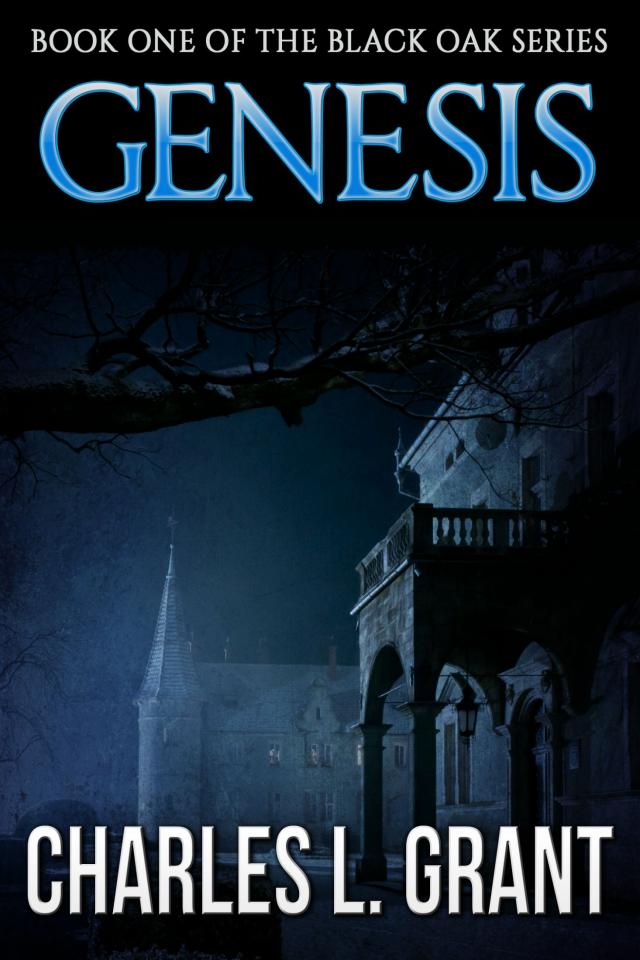


BLACK OAK #1: GENESIS
By Charles L. Grant
A Macabre Ink Production
Macabre Ink is an imprint of Crossroad Press
Digital Edition published by Crossroad Press
Smashwords edition published at Smashwords by Crossroad Press
Digital Edition Copyright 2016 Kathryn Ptacek
Copy-edited by: Duncan Douglas
LICENSE NOTES
This eBook is licensed for your personal enjoyment only. This eBook may not be re-sold or given away to other people. If you would like to share this book with another person, please purchase an additional copy for each person you share it with. If you’re reading this book and did not purchase it, or it was not purchased for your use only, then you should return to the vendor of your choice and purchase your own copy. Thank you for respecting the hard work of this author.
Meet the Author
Photo by Jeff Schalles
Charles L. Grant taught English and history at the high school level before becoming a full-time writer in the ’70s. He served for many years as an officer in the Horror Writers Association and in Science Fiction Writers of America.
He was known for his “quiet horror” and for editing the award-winning Shadows anthologies. He received the British Fantasy Society’s Special Award in 1987 for life achievement; in 2000, he was the recipient of the Lifetime Achievement Award from HWA. Other awards include two Nebula Awards and three World Fantasy Awards for writing and editing.
Charlie died from a lengthy illness on September 15, 2006, just three days after his birthday. He lived in Newton, NJ, and was married to writer/editor Kathryn Ptacek for nearly twenty-five years.
Book List
Horror
Novels
Black Oak: Genesis
Black Oak: The Hush of Dark Wings
Black Oak: Winter Knight
Black Oak: Hunting Ground
Black Oak: When the Cold Wind Blows
Fire Mask
For Fear of the Night
In A Dark Dream
Jackals
Millennium Quartet #1: Symphony
Millennium Quartet #2: In the Mood
Millennium Quartet #3: Chariot
Millennium Quartet #4: Riders in the Sky
Night Songs
Raven
Something Stirs
Stunts
The Bloodwind
The Curse
The Grave
The Hour of the Oxrun Dead
The Last Call of Mourning
The Nestling
The Pet
The Sound Of Midnight
The Tea Party
The Universe of Horror Trilogy
The Soft Whisper of the Dead
The Dark Cry of the Moon
The Long Night of the Grave
Collections
Dialing the Wind
Nightmare Seasons
The Black Carousel
The Orchard
Science Fiction
A Quiet Night of Fear
Ascension
Legion
Ravens of the Moon
The Shadow of Alpha
As “Geoffrey Marsh”
The Fangs of the Hooded Demon
The King of Satan’s Eyes
The Patch of the Odin Soldier
The Tail of the Arabian, Knight
As “Lionel Fenn”
The Quest for the White Duck Trilogy
Blood River Down
Web of Defeat
Agnes Day
668, the Neighbor of the Beast
By The Time I Get To Nashville
Mark of the Moderately Vicious Vampire
Once Upon a Time in the East
The Once and Future Thing
The Really Ugly Thing From Mars
The Reasonably Invisible Man
The Seven Spears of the W’dch’ck
Time, the Semi-Final Frontier
As “Simon Lake”
Daughter of Darkness
Death Cycle
Death Scream
He Told Me To
Shapes Berkley
Something’s Watching
The Clown
The Forever House
As “Felicia Andrews”
Moonwitch
Mountainwitch
Riverrun
Riverwitch
Seacliffe
Silver Huntress
The Velvet Hart
As “Deborah Lewis”
Eve of the Hound
Kirkwood Fires
The Wind at Winter’s End
Voices Out of Time
DISCOVER CROSSROAD PRESS
Visit us online
Check out our blog and
Subscribe to our Newsletter for the latest Crossroad Press News
Find and follow us on Facebook
Join our group at Goodreads
We hope you enjoy this eBook and will seek out other books published by Crossroad Press. We strive to make our eBooks as free of errors as possible, but on occasion some make it into the final product. If you spot any problems, please contact us at publisher@crossroadpress.com and notify us of what you found. We’ll make the necessary corrections and republish the book. We’ll also ensure you get the updated version of the eBook.
If you’d like to be notified of new Crossroad Press titles when they are published, please send an email to publisher@crossroadpress.com and ask to be added to our mailing list.
If you have a moment, the author would appreciate you taking the time to leave a review for this book at whatever retailer’s site you purchased it from.
Thank you for your assistance and your support of the authors published by Crossroad Press.
This is for Bill, USPS, without whose patience and lousy jokes I’d have a whole lot of manuscripts in my house;
And Barbara, USPS, the same but a lot cuter. Except for the jokes.
Thank you both.
BLACK OAK #1: GENESIS
ONE
The sky was still light, no stars yet, no moon. But the river-split valley was already dark, the Cumberland Mountains hiding the last of the sun. Bands of thick mist reached out of the woods, curling under at the road, like claws ready to pull a great beast from the trees.
The headlights only made it worse, making the black more dark, and the trees that crowded the verge more like a solid wall.
Sloan Delany rubbed his eyes with the knuckles of his left hand and reluctantly decided it might be time to give it up and change direction.
On the other hand, surrendering now would mean ending his vacation without reaching the final goal.
Unlike others he knew, who either headed for resorts or stayed home to mow the lawn, he went on the road and searched for places that sold the worst kitsch he could find. A shop in Pennsylvania, where he picked up tiny Amish farmers carved out of potatoes and lacquered; a roadside stand outside Ottawa where he found, of all things, a matching pair of varnished piranha mounted on coral stands; a store in Memphis, with Elvis in loincloth salt and pepper shakers.
Sometimes he flew to a city like Salt Lake, or Chicago … rented a car and drove. It didn’t make any difference, as long as he found something that would add bizarre class to his collection and, in the bargain, make his friends wince and wonder about his mind.
Roadside America was his cultural Bible; off-kilter museums his shrines.
This time it was a place someone had told him about while he’d been in Lexington, trying to decide whether the crocheted Secretariat toilet covers were neat, or just tasteless. He had strict unwritten tests based primarily on instinct, and the covers, eventually, did not pass.
The new information, however, was intriguing. The bartender had no map, just vague directions to an area called Crockston in the eastern part of the state, and he had figured he could check it out on the way home.
Assuming, that is, that he could find the damn place.
One pickup heading in the opposite direction had been the only other vehicle he had seen in the past hour. There were two well-kept campgrounds, but the offices had been empty; a collection of houses in a clearing that grazed the road had darkened windows, although the dogs when he approached them made enough racket to raise the dead.
The mist shattered against the windshield. The road climbed and fell in slow curves.
He rubbed his eyes again, and yawned so widely his jaw popped.
Every so often something glittered in the trees, specks of different colors. Animal eyes. Shards of glass. Mica in the occasional moss-draped boulder.
The radio produced nothing but static, or rapid tinny voices too faint to understand.
Finally he opened the window a little, just for the wind-noise, just for the sound.
This, he thought, is stupid. Go home, boy, go home, forget it.
Another mile, and he realized the sky had finally gone dark, and a pale moon sat over the mountains. Its feeble light helped some, but not enough. The trees were still too dark, the road still too empty.
Maybe he should just give it up. Find the next major intersection and head east into Virginia. If he were lucky, he’d come on the interstate fairly soon, which would mean a motel and a restaurant. And people. If he got up early and pushed it, he could be home by midnight tomorrow. It wasn’t as if he didn’t have enough stuff in his trunk—pieces for his collection, and some gifts for the guys, who would tell him he was nuts and that he ought to save his money.
All except Proctor. Proctor knew.
; Proctor understood.
Delany wasn’t about to save his money, because there was nothing, or anyone, to save it for, and he sure as hell wasn’t going to take what little there was in the bank with him.
Proctor knew; he understood.
A speed-limit sign glared past, pocked with rusted bullet holes.
“For God’s sake,” he muttered, “don’t these people need directions? What, are they all goddamn Daniel Boone?”
The magic words.
On the left side of a sharp eastward curve, almost hidden by trailing branches, he saw the billboard:
Cumberland Motel and Museum of the Odd. 5 miles
“Bingo,” he shouted, and slapped the steering wheel with his palms. “About goddamn time.”
He crossed a bridge with open-girder sides, saw black water carrying sparkling highlights of the moon; he followed another curve into a long tunnel that had no lights at all, and no sign it would ever end.
You’re tired, boy, he told himself; thinking like that’s gonna spook you into a bottle.
Still, he was relieved to see the moon on the other side, and wished he could see some animals on the road, dead or alive. So far there had been nothing, not even a bird.
He hummed the Twilight Zone theme, glanced at the empty passenger seat, and said, “You want to see something really scary?”
He laughed, and raised a triumphant fist when he spotted the light up ahead, on the right. A glaring white flood that slowed the car and let him breathe easily.
His destination was a long log cabin with a deep porch and a high slanted roof, a crushed-gravel parking lot to its right, and what looked to be smaller cabins ranged north on the left. A smaller sign at the entrance matched the billboard’s plain lettering; a neon sign just below it promised him a vacancy. If there was peeling paint or sagging beams, holes in the roof or weeds, the darkness hid them.
He pulled in beside the main building, switched off the ignition, and closed his eyes for a moment. This time the silence was gentle, not a threat. He blew out, shook himself, and opened the door.
“Damn!”
It was Wednesday in mid-October, but the mountain air was winter-chilled, catching him by surprise. A hard hand rubbed across his face; he reached into the backseat and grabbed his suitcase, stamped the ground a little to bring his legs back to life, and headed for the porch.
Ignoring the mist his shoes kicked into tatters.
Inside, the place felt fireplace warm.
On the left was a large room, long tables set for family-style dining, each table with matching long benches; on the right a gift shop that didn’t look too promising—standard display cases with standard Appalachian items arranged on white cloth. Bare hardwood floors; framed oils and watercolors on the walls, all for sale. Local artists, he reckoned by all the hand-lettered signs, and by the looks of them, not all that good.
Neither room was occupied, not even a waitress or clerk trying to look busy.
Directly ahead was a paneled registration desk framed by gleaming dark wood; no one there either.
He raised an eyebrow, called a “Hello?” and startled himself at how loud he sounded.
He was startled a second time when he heard a muffled response, and had nearly completed a full turn looking for the source, when a door opened behind the counter and a woman stepped out. Smiling. Wiping her hands on a towel.
“Sorry,” she said as he walked over. “Didn’t hear you over the TV.”
He could hear it now, the clear sound of a baseball game.
She didn’t seem to be much younger than he, probably in her late forties. Brown hair cropped pragmatically short, lean and lightly tanned, in a plaid shirt with rolled-up sleeves, and jeans that hung slightly loose.
He set the suitcase down and massaged the small of his back with one hand. “Got a room?”
“Cabins.”
“No problem.” Another look at the dining room. “Am I the only one tonight?”
She slid a short form in front of him, dropped a ballpoint beside it. “Nope. Couple of hunters. They’re already racked for the night.”
As he filled in the information he asked about the chances of getting something to eat, and was told the kitchen was open most of the day. A grin: “That is, when I’m around and awake.”
He returned the grin, and after completing the registration form, asked about the museum’s hours. The look she gave him made him wonder if he’d inadvertently tripped over some local social taboo.
“You’re not a reporter,” she said, less asking than accusing.
“No. It’s what I do on my vacation—look for weird stuff. Buy really tacky stuff.” He gestured vaguely at the gift shop. “Unfortunately, that looks too good for my taste.”
Clearly she didn’t know whether to laugh or be insulted, not even when he smiled to prove he’d meant no offense and was telling the truth. He held up a finger—hold on a minute—and knelt to open his suitcase. He could sense her leaning over the counter as he rummaged through his clothes, feeling his way toward something he’d picked up outside Louisville two days ago.
“Ah.” He straightened, and set a pink tissue-paper bundle on the counter between them. “Just to give you an idea.”
She stared at it.
“Go ahead, open it, I don’t mind.”
Still dubious, but finally willing, she took the paper off carefully, blinked, and said, “You have got to be kidding.”
It was a glossy ceramic statuette of a Tennessee walker, about five inches high, including the base that was supposed to be a field of grass and looked like two saws with green, rotting teeth. In front of the horse was a tiny black man in a jockey’s outfit. Set into the horse’s belly was a thermometer.
“You paid money for this?”
“Awful, ain’t it,” he said proudly.
She nodded, looked at him sideways, touched the top of the horse’s head, and nodded again. “You got more of this stuff.”
“Right.”
“Just as awful.”
“Absolutely.”
“And at home? On … on the mantel?”
“Lord, no. I got a special room.” A quick shrug. “Most of it, anyway.”
Her smile was broad. It took no years off, but it made him realize she wasn’t plain at all. “You unpack, Mr. Delaney—”
“Sloan.”
“Sloan.” She held out her hand. “Maggie. Maggie Medford. You unpack, freshen up, I’ll have some dinner waiting for you in an hour. Nothing fancy.” Another look at the walker. “Better than that, though, I hope. Then I’ll show you the museum.”
He almost agreed, but was interrupted by a yawn that seemed to go on forever. When it was over, his eyes had watered and there was a near cramp in his neck.
“Better idea,” he suggested, apologizing with a look. “I have to leave pretty much first thing, and I’m obviously more tired than I thought. Could we … I mean, would it be okay if we did the museum now, then eat? If I go back to the room now, I’m not leaving, believe me.”
“Your dime,” she said, unconcerned.
“My dime.”
“Actually,” she said, holding out a palm and waggling her fingers, “it’s five bucks.”
Now this, Delany thought gleefully, is what I live for.
The Museum of the Odd was in a long room behind the gift shop, reached through double glass doors Maggie slid aside from the center, under a flickering neon sign that announced its name.
There was no overhead lighting.
Here, despite the cool of the night outside, the air-conditioning was still on, just enough to feel it across the shoulders, along the arms.
Worn carpeting on the floor muffled his footsteps, and it was too dim to make out the pattern; just a series of dark splotches.
On either side of a center aisle were waist-high display cases lit from within. The oddities they contained were similar to those he had seen before— roots shaped like faces or small animals or human babies in fetal positions; animal skeletons, each with a deformity that ranged from swollen skulls to multiple limbs; a glittering rock, supposedly a meteorite; geodes; a small open book bound in cracked hide, allegedly a diary belonging to Daniel Boone; a yellowed scrap of paper the 3x5 card beside it claimed held Andrew Jackson’s signature; a page from another book, claiming an eighteenth century prophecy of both World Wars.
A tangle of moss said to be the Devil’s hair.
Maggie followed him, saying nothing as he examined each one, grunting his pleasure, shaking his head only once—at the Devil’s hair—and looking at her with a half smile, receiving only a shrug in return.