Fire mask, p.1
Fire Mask, page 1
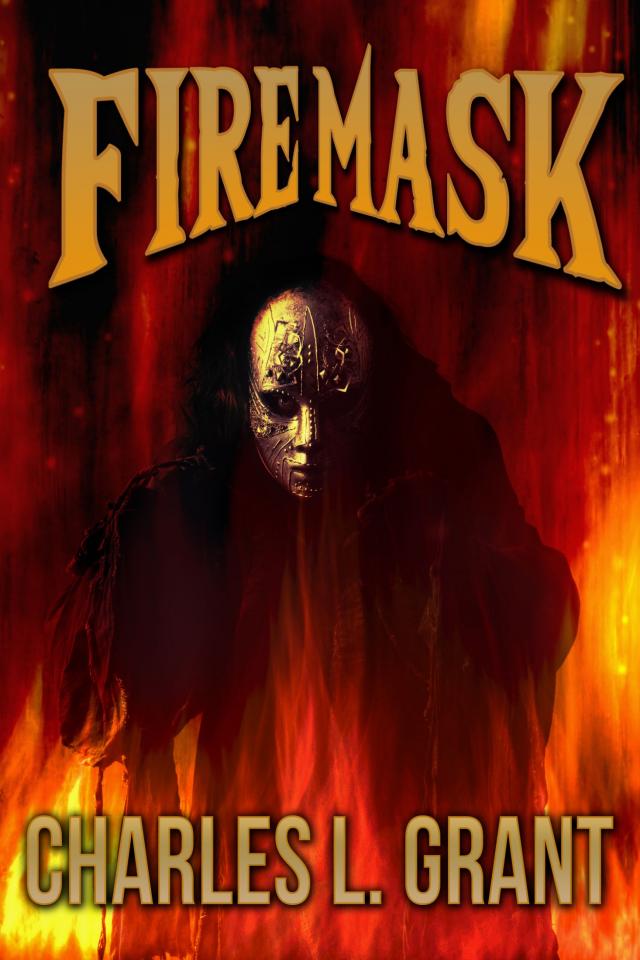


FIRE MASK
By Charles L. Grant
A Macabre Ink Production
Macabre Ink is an imprint of Crossroad Press
Digital Edition published by Crossroad Press
Smashwords edition published at Smashwords by Crossroad Press
Digital Edition Copyright © 2018 Kathryn Ptacek
Original publication by Bantam Books—1991
LICENSE NOTES
This eBook is licensed for your personal enjoyment only. This eBook may not be re-sold or given away to other people. If you would like to share this book with another person, please purchase an additional copy for each person you share it with. If you’re reading this book and did not purchase it, or it was not purchased for your use only, then you should return to the vendor of your choice and purchase your own copy. Thank you for respecting the hard work of this author.
Meet the Author
Photo by Jeff Schalles
Charles L. Grant taught English and history at the high school level before becoming a full-time writer in the ’70s. He served for many years as an officer in the Horror Writers Association and in Science Fiction Writers of America.
He was known for his “quiet horror” and for editing the award-winning Shadows anthologies. He received the British Fantasy Society’s Special Award in 1987 for life achievement; in 2000, he was the recipient of the Lifetime Achievement Award from HWA. Other awards include two Nebula Awards and three World Fantasy Awards for writing and editing.
Charlie died from a lengthy illness on September 15, 2006, just three days after his birthday. He lived in Newton, NJ, and was married to writer/editor Kathryn Ptacek for nearly twenty-five years.
Book List
Horror
Novels
Black Oak: Genesis
Black Oak: The Hush of Dark Wings
Black Oak: Winter Knight
Black Oak: Hunting Ground
Black Oak: When the Cold Wind Blows
Fire Mask
For Fear of the Night
In A Dark Dream
Jackals
Millennium Quartet #1: Symphony
Millennium Quartet #2: In the Mood
Millennium Quartet #3: Chariot
Millennium Quartet #4: Riders in the Sky
Night Songs
Raven
Something Stirs
Stunts
The Bloodwind
The Curse
The Grave
The Hour of the Oxrun Dead
The Last Call of Mourning
The Nestling
The Pet
The Sound Of Midnight
The Tea Party
The Universe of Horror Trilogy
The Soft Whisper of the Dead
The Dark Cry of the Moon
The Long Night of the Grave
Collections
Dialing the Wind
Nightmare Seasons
The Black Carousel
The Orchard
Science Fiction
A Quiet Night of Fear
Ascension
Legion
Ravens of the Moon
The Shadow of Alpha
As “Geoffrey Marsh”
The Fangs of the Hooded Demon
The King of Satan’s Eyes
The Patch of the Odin Soldier
The Tail of the Arabian, Knight
As “Lionel Fenn”
The Quest for the White Duck Trilogy
Blood River Down
Web of Defeat
Agnes Day
The Kent Montana Series
The Really Ugly Thing From Mars
The Reasonably Invisible Man
The Once and Future Thing
The Mark of the Moderately Vicious Vampire
668, the Neighbor of the Beast
The Diego Series
Once Upon a Time in the East
By The Time I Get To Nashville
Time, the Semi-Final Frontier
The Seven Spears of the W’dch’ck
As “Simon Lake”
The Midnight Place Series
Daughter of Darkness
Death Cycle
He Told Me To
Something’s Watching
As “Felicia Andrews”
Moonwitch
Mountainwitch
Riverrun
Riverwitch
Seacliffe
Silver Huntress
The Velvet Hart
As “Deborah Lewis”
Eve of the Hound
Kirkwood Fires
The Wind at Winter’s End
Voices Out of Time
DISCOVER CROSSROAD PRESS
Visit us online
Check out our blog and
Subscribe to our Newsletter for the latest Crossroad Press News
Find and follow us on Facebook
Join our group at Goodreads
We hope you enjoy this eBook and will seek out other books published by Crossroad Press. We strive to make our eBooks as free of errors as possible, but on occasion some make it into the final product. If you spot any problems, please contact us at publisher@crossroadpress.com and notify us of what you found. We’ll make the necessary corrections and republish the book. We’ll also ensure you get the updated version of the eBook.
If you’d like to be notified of new Crossroad Press titles when they are published, please send an email to publisher@crossroadpress.com and ask to be added to our mailing list.
If you have a moment, the author would appreciate you taking the time to leave a review for this book at the retailer’s site where you purchased it.
Thank you for your assistance and your support of the authors published by Crossroad Press.
Table of Contents
ONE
TWO
THREE
FOUR
FIVE
SIX
SEVEN
EIGHT
NINE
TEN
ELEVEN
TWELVE
THIRTEEN
FOURTEEN
FIFTEEN
SIXTEEN
SEVENTEEN
EIGHTEEN
NINETEEN
TWENTY
TWENTY-ONE
ONE
Cliff didn’t stir when the sirens began wailing. He was much too comfortable to even think about moving.
It was just possible, in fact, that this was the way he was going to spend the rest of his life. It certainly beat mowing the lawn; it was definitely better than being worked to death in the vegetable garden; and it sure won hands down over doing the dishes after his sister had done the cooking.
He sighed contentedly.
Yes, he thought, I am definitely not moving until they carry me away.
The porch hammock swayed gently; the temperature had settled to just this side of cool, and July’s humidity hadn’t yet climbed from barely felt to intolerable. A breeze now and then made the leaves whisper to themselves, and the usual population of flying insects appeared to be on welcome vacation.
All in all, a reasonably decent summer’s night.
He yawned, and grinned at the dark when he heard his jaw crack.
A car drifted past, radio muted, its headlights turning the lower branches gray and slapping running shadows onto the porch floor.
Behind him, through the open living-room window, he could hear the muffled sounds of a ball game on television and his father exhorting his team to stop screwing around and get down to business before football season started. His sister, Jill, was gabbing with her boyfriend on the center hall telephone for the umpteenth time today, giggling like a jerk and deliberately speaking low to keep Dad from eavesdropping. And his mother was in the kitchen, arguing with the parrot over the homemade pizza they’d had for dinner.
It was a few minutes past eight, the sun down, the cicadas buzzing, and not a hint of a cloud to spoil the stars he could see over the rooftops.
He sighed again.
He cupped his hands behind his head.
He looked over the porch railing to the shadowed empty street, lifted his face to a breeze that slipped over him without warning, and wondered what the chances were that someone would come by to see him tonight. Surprise him. Like Candy Nagger, for instance.
He closed his eyes and put a hand to his chest.
In a bathing suit.
He groaned and told himself to knock it off before he gave himself a heart attack.
But why not? It could happen, right? She would drive up, ask him to go to the park with her, watch a town league game on the diamond, then head over to Stuffy’s for a burger and belly-buster sundae while she openly and extravagantly admired his wit and wisdom.
Why not?
Or maybe Del Ingram’s older sister, Susan, would dump her college boyfriend so she could take him for a ride in her yellow convertible … and not bring Del with her.
Sure, he thought glumly, and tomorrow I’ll win the lottery and buy my own mountain.
He shifted.
He fell out of the hammock.
“You okay, sport?” his father called.
“Yeah, sure, fine,” he answered, sprawled flat on his back, staring up at the porch roof and rubbing his butt. Don’t worry about me, Dad, he thought; it’s only a flesh wound. I’ll be all right. Don’t bother to get up.
He groaned, winced at a twinge in his elbow, and pushed himself slowly to his feet.
A second call of sirens.
His father came to the window and peered through the screen. “What’s that?”
“There’s a riot up on President,” Cliff told him, leaning over the railing and squinting up Fillmore Road, into the dark. “Newsome’s Drugs ran out of curlers, and Jill’s demanding justice and compensation for mental anguish. Tomorrow she’s going to chain herself to the White House fence.”
Edward Abbott grunted and shook his head. “You shouldn’t make fun of your big sister like that,” he said as if he were commenting on the weather. “She does very well with what she has. You should be proud of her.”
“Sure,” he said.
What Jill had, he knew and would admit to no one but himself, was the kind of simple, natural beauty that made men stop in their tracks and women scowl with envy. He’d seen it. He didn’t get it, but he’d seen it happen more than once. And to make matters worse, she was smart. She’d graduated from Rushmore High second in her class and was headed for Princeton on a full academic scholarship.
It was people like that who made life miserable for people like him.
The parrot yelled something in Italian.
His mother yelled back, in English plain enough to make Cliff wonder if she’d ever been in the marines.
“How’s the game?” he asked.
His father grunted.
“Too bad.”
“It’s only July. Wait until August. I’ll know then if I have to cut my throat again.”
Cliff laughed silently, thinking that it was a good thing his father wasn’t a professional gambler. The day he ever backed a team that won it all would be the day Candy Nagger threw herself into his arms and begged him to take her away from all this, to his castle in the mountains.
He prayed every night that his father would pick a winner.
He frowned when he spotted a faint orange glow above the trees, and moved to the stairs for a better look. “Hey, Dad, I think there’s a fire.” He pointed. “Really.”
“So go look,” his father said. “Bring back a full report.”
Cliff grinned. If World War III broke out in the middle of the World Series, his father would send him out for a report, just so he wouldn’t miss a single pitch.
The parrot shrieked.
“You know,” his father grumbled as he pulled away from the window, “there are times when I wonder about that stupid bird.” A moment later, the screen door opened, and Cliff’s denim jacket flew across the porch. “In case you get chilly,” he was told gruffly. “Wear it. Don’t complain. Your mother has ears like a hawk.”
Without a word he slipped on the jacket and walked down the flagstone path to the sidewalk. He noted as he stepped onto the pavement that the hedge fronting the yard needed trimming again, and he crossed his fingers in the hope that neither of his parents had noticed it.
Cliff glanced up and down the street, frowning.
Something …
He shook his head.
Something wasn’t …
He stared at the glow outlining the rooftops, flickering now and laced through with twisting darker shades he decided must be smoke. He couldn’t figure out exactly where it was except that it had to be downtown someplace, on President Avenue, so he moved off in a slow trot, frowning again when the wind shifted and he caught the smell of burning wood.
The sirens were louder, and there were more of them.
Cliff picked up his pace, his heels echoing, his breath loud in his ears. He darted in and out of shadow, glancing side to side at the large old houses that lined Fillmore Road, and the large old trees that reached as high as chimneys and higher, their branches heavy with foliage, twisted with age. He swerved around an automobile poorly parked in a driveway, its metal creaking as its engine cooled, its rear window reflecting nothing but pinpoints of flickering white; slowed when a tomcat strolled out from behind a hedge, hissed at him, and ducked back; looked over his shoulder when a dog barked; and stared straight ahead when a car drifted by and someone yelled his name and someone else laughed.
He shivered and rolled his shoulders.
He wasn’t cold; it was the night.
There was something about it, something he hadn’t noticed before.
Nuts, he thought. He hated it when he got these feelings, because whenever he tried to do something about them, they usually managed to get him into trouble.
But he couldn’t ignore them.
Something was different about his town tonight.
He wasn’t sure what it was, but he sensed it wasn’t good. It was as if something in the neighborhood had been replaced with something that looked right but wasn’t right, and he had no idea why that was.
He paused and slapped himself lightly on the cheek.
Knock it off, Abbott, he told himself. You’re heading for the loony bin.
Immediately, he turned the trot into a sprint, racing across the street, two blocks, three, slowing on the fourth when the glow began to seep through the leaves and stain the ground. There were people out now, talking quietly to each other, watching the sky as they headed in the same direction.
The sirens were louder still, some of them winding down, and something else just behind them—like the sound of the ocean, a distant constant roaring.
Then he turned onto President Avenue and stopped in his tracks.
His eyes widened, he felt his mouth drop open, and he moved to the curb where he stood beside a lamppost, one arm wrapped around it.
“Wow,” he whispered, partly in fear, partly in awe, and couldn’t help thinking that this must be what the end of the world will be like.
TWO
The business district in Rushmore began on the corner where Cliff stood and stretched to the railroad tracks, six long blocks away. Many of the buildings were converted private homes dating back to the turn of the century, with shops on the first floor, offices on the second and third; they also had porches and lots of fancy woodwork. Those that hadn’t been homes originally were wood-and-brick combinations jammed together on small lots, housing the clothing stores, the luncheonettes, and the town library. The others, like the gray marble national bank, the two local department stores, and a new brick office complex down by the tracks, were higher.
But the tallest was the white-and-green Rushmore Restaurant and Hotel, four floors above a two-story lobby, each floor with a balcony, each one boasting high, arched windows that made the structure look much bigger than it was. Its two first-floor restaurants were the town’s most expensive, its lounge a favorite among the younger businessmen, and its rooms as large as many big-city suites.
It was three blocks away, and it was engulfed in flame.
Cliff couldn’t believe it. That old place had been around practically forever, and now there were fire trucks and cruisers and ambulances all over the street, while yellow sawhorse barriers were being hastily set up to keep the growing crowds at a safe distance.
A cop at the intersection directed traffic away, too busy to answer when Cliff yelled a question about the fire’s cause. The people lining the curbs and standing between parked cars were strangers to him, but he didn’t want to move any closer; as it was, he felt as though the building might fall on him at any minute.
Then a hand slapped his shoulder. He turned with a start; it was Del Ingram, sweatshirt stained with perspiration, cutoffs not very flattering to his large, pale thighs.
“Something else, huh?” Del said, his face touched with orange, his red hair redder and his freckles almost black in the unnatural light.
“I can’t believe it.”
“Like somebody dumped gas all over it, y’know? Bam! One minute it’s fine, the next minute it’s gone. Wow. Never saw anything like it in my life.”
Cliff stared at him. “You saw it start? Really?”
Del nodded toward Stuffy’s Luncheonette, a few doors down. “I didn’t exactly see it. Not exactly. I was having a snack, see, watching the ladies. The next thing I know the whole place has gone up. Wow.”
They looked back at the fire, feeling its heat begin to dry their skin. The street was completely cordoned off now, the police moving the crowds back. Fire engines were parked helter-skelter, and great plumes of water poured uselessly into the flames. The sound was deafening. He almost had to shout to make himself heard.
“You know how it started?”
Del shrugged. “Beats me. All I saw was people running out. Next thing I know, Stuffy’s is empty, and here I am.”
“Incredible,” he whispered.
There was a long, crackling roar then, and part of the roof collapsed in a tornado of sparks and flame. People began edging away, some slowly, some almost at a trot, and most of the fire hoses switched their aim to the buildings flanking the hotel, obviously hoping to keep the fire from jumping roof to roof and burning down the whole district.