Son of man, p.1
Son of Man, page 1
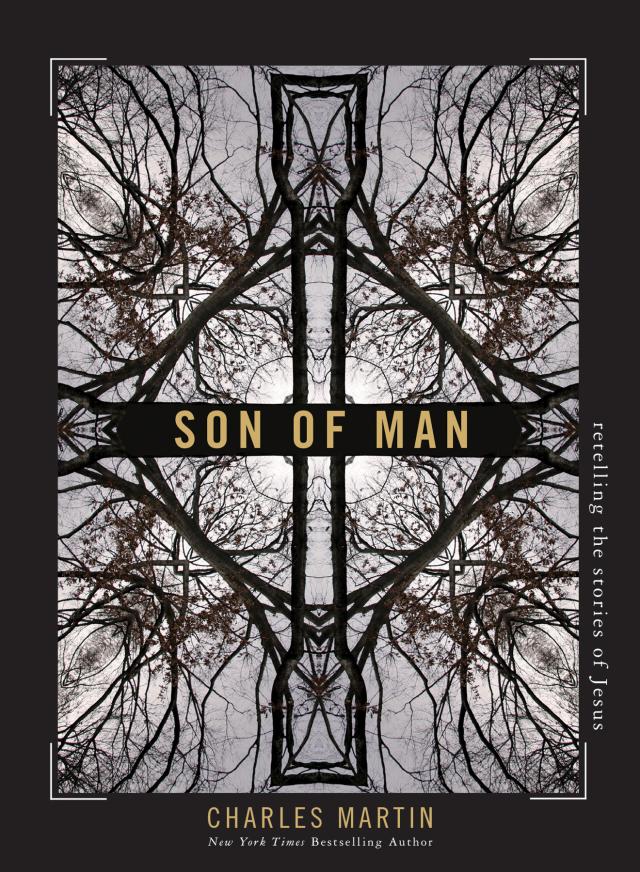


Son of Man
© 2023 Charles Martin
Portions of this book were excerpted and adapted from What If It’s True? © 2020 and They Turned the World Upside Down © 2021.
All rights reserved. No portion of this book may be reproduced, stored in a retrieval system, or transmitted in any form or by any means—electronic, mechanical, photocopy, recording, scanning, or other—except for brief quotations in critical reviews or articles, without the prior written permission of the publisher.
Published in Nashville, Tennessee, by W Publishing, an imprint of Thomas Nelson.
Published in association with the Christopher Ferebee Agency.
Thomas Nelson titles may be purchased in bulk for educational, business, fund-raising, or sales promotional use. For information, please email SpecialMarkets@ThomasNelson.com.
Unless otherwise noted, Scripture quotations are taken from the New King James Version®. Copyright © 1982 by Thomas Nelson. Used by permission. All rights reserved.
Scripture quotations marked ESV are taken from the ESV® Bible (The Holy Bible, English Standard Version®). Copyright © 2001 by Crossway, a publishing ministry of Good News Publishers. Used by permission. All rights reserved.
Scripture quotations marked KJV are taken from the King James Version. Public domain.
Scripture quotations marked NASB are taken from the New American Standard Bible® (NASB). Copyright © 1960, 1962, 1963, 1968, 1971, 1972, 1973, 1975, 1977, 1995, 2020 by The Lockman Foundation. Used by permission. www.Lockman.org
Any internet addresses, phone numbers, or company or product information printed in this book are offered as a resource and are not intended in any way to be or to imply an endorsement by Thomas Nelson, nor does Thomas Nelson vouch for the existence, content, or services of these sites, phone numbers, companies, or products beyond the life of this book.
ISBN 978-1-4003-3353-0 (eBook)
ISBN 978-1-4003-3354-7 (audiobook)
Library of Congress Cataloging-in-Publication Data on File
ISBN 978-1-4003-3352-3
Epub Edition December 2022 9781400333530
Printed in the United States of America
2223242526LSC10987654321
Information about External Hyperlinks in this ebook
Please note that the endnotes in this ebook may contain hyperlinks to external websites as part of bibliographic citations. These hyperlinks have not been activated by the publisher, who cannot verify the accuracy of these links beyond the date of publication
CONTENTS
Cover
Title Page
Copyright
Introduction
Entering the Courtroom
God with Us
Daughter of God
Only Believe
In the Power of Jesus
The Good Confession
Neither Do I Condemn You
Where the Father’s Love Found Him
The Signature of the Messiah
By This . . .
The Covenant
Betrayed
King of the Jews
The Father’s Silence
Propitiation
Enter the King of Glory
The Borrowed Tomb
Can It Be?
On the Road to Emmaus
The Do-Over
What Next?
The Helper Comes
Fearless
Blinded to See
The Banquet of the Ages
Endnotes
INTRODUCTION
He can’t fix this mess. He stares down at the road below him and knows, beyond a shadow of any doubt, he is powerless to do anything about anything. The consequences of his life’s choices have caught up with him. Right here. He’s a criminal. Draped in regret. Convicted of multiple crimes. His sentence is crucifixion. This is literally the end of the road. Sometime today, or tonight, his life will end. He’s not sure how long he’ll last. But given that Sabbath is a few hours away, he’s pretty sure the soldiers will break his legs with that heavy iron bar, and he won’t be able to push up to breathe. The clock ticks. It’s not long now.
He is hanging on a cross outside of Jerusalem, AD 33. To his right hangs his friend. Or at least a fellow criminal. I doubt they’re friends as much as partners in crime. Between them is a man he’s never met. But the man must have done something awfully wrong because He is shredded like burger. Nothing remains of His back, sides, and shoulders. In fact, He doesn’t even look like a man. And while our criminal is tied to his cross, the man in the middle has been nailed to His. Hands and feet. Whatever happened to the man on the middle cross prior to His arrival here must have been horrific because it looks as if all His bones are out of joint. Above His head a sign reads “King of the Jews,” but judging by the mocking shouts of those surrounding Him, few believe it.
The soldiers seem to be enjoying themselves. They spit on the man in the middle. Gamble for His clothes. And one of the soldiers takes a sponge on a stick, called a tersorium, dips it in feces-laced vinegar, and shoves it into His mouth. The man doesn’t like it. He is struggling to remain conscious, and it appears the weight of the world is hanging on His shoulders.
The man speaks in Aramaic. Suggesting He’s a Galilean. A Hebrew. A woman, evidently the man’s mother, approaches. He says something to her. She cries on the shoulder of another man. That her heart is pierced is obvious.
Now the man is praying. Talking to God. He calls Him Father. They must know each other because it sounds as if He’s done that before. A lot.
The second criminal is indignant. Cussing the man on the middle cross. Railing. “Are you not the Christ? Save yourself and us!”
The first thief rebukes the second. “Do you not fear God since you are under the same sentence of condemnation? And we indeed justly, for we are receiving the due reward of our deeds . . .” His words tell us much about him.
For starters, he’s telling the truth. Sees himself clearly. No more lies. He got what he deserved. But not the man in the middle. Then he says, “Jesus, remember me when You come into Your kingdom.”
Hold it.
Why does he say this? What happened? There are two criminals. One on Jesus’ left. One on His right. One believes. One mocks. They’re both looking at the same Jesus. What gives?
Here’s what I think. Early in His earthly ministry, Jesus said, “As Moses lifted up the serpent in the wilderness, even so must the Son of Man be lifted up, that whoever believes in Him should not perish but have eternal life.”1 This comes just before the most famous verse in the Bible.
Back up briefly. The Israelites have made their exodus. Left Egypt. Now they’re wandering the desert. Complaining. Cussing God, “Things were better when we were slaves.” God sends snakes to bite them. Many die. Then God speaks the remedy, “Make a bronze serpent and put it on a pole. Everyone who looks at it will be healed and not die.”
The condition was that you had to come forward, look up, admit you are the cause of your own sickness, and confess you can’t fix you. God alone can. Looking up was an outward expression of an inward condition. Humility. “I did this. I sinned. Forgive me, please.”
It’s a picture of repentance.
According to Jesus, God was setting up the conditions for our return to Himself. Jesus must be lifted up. Crucified. Which is happening right next to our criminal. The single most important day in human history, and he has a front-row seat.
My question is this: How does he believe and the other criminal not? What happened to move his heart from not believing to believing?
Well, according to Scripture, God got tired of his not believing and did a thing in his heart. But let’s look closer at what we see. Right there, just a few feet away, before his very eyes, hangs Jesus. The Son of God.
And two words reveal the thief’s heart: Your kingdom.
We have no idea what he thought or believed about this Jesus prior, but in that moment, he believes Jesus is who the sign above His head declares Him to be. The Son of God. The King with a kingdom. And that today, after some time of absence, He’s returning to it.
This belief that Jesus is who He says He is, is probably not the thinking that landed the thief on that cross. But of all the people in Scripture, of all the saints, we know something about this criminal that cannot be said of any other saint or person in Scripture. We know, beyond a shadow of a doubt, that He is with Jesus. Right this second. “Assuredly, I say to you, today you will be with Me in Paradise.”2
What has the thief done to earn this?
He’s not gone to church. Hasn’t amended his ways or paid back all he owes. He hasn’t studied great theological truths. Hasn’t joined a discipleship group. Hasn’t served at his local church. Hasn’t visited the prisoners. Hasn’t fed the poor. Hasn’t taken care of widows and orphans. He can’t even lift his hands in worship because they’re tied to the crossbar. This dude hasn’t done squat and yet, according to Jesus, this criminal is in heaven as I write this.
Which means there’s hope for us.
This inexplicable thing that Jesus does—this grace, this unmerited mercy, this salvation, this snatching back out of the hand of the devil—is a gift beyond measure. We can’t earn it and don’t deserve it. In fact, every one of us deserves the very crucifixion Jesus suffers. But for reasons I cannot fathom, He hangs there.
So let’s go back a few steps. What happened? Just yesterday, the criminal was . . . a criminal. He got caught, had a trial, was convicted, marched out of town, and unceremoniously hung on this tree. And by his own admission, he deserves it. What happened between yesterday and right now?
I think the answer lies in the criminal’s view. His perspective. Look through his eyes. Watch what he’s watching. The man on the middle cross is drowning in his own lung fluid. Now listen with his ears. “Father, forgive them.” “I thirst.” “Mother, behold your son.” Now smell with his nose. He’s outside the town, out where they burn the trash. He’s also close enough to smell Jesus’ sweat and blood.
In this moment, Jesus is anything but kingly. Or is He?
Throughout Scripture, whenever someone encounters Jesus, they see something—or someone—they’ve never seen. They see themselves in relation to Him. And there’s no comparison. They fall on their faces and want to crawl into a hole. Disappear. They use words like unclean and not worthy. The juxtaposition is a chasm they can’t cross. They can’t wrap their minds around Him.
You and I have a problem. And while there is great disagreement among most people about most things on planet Earth, most will agree that things here are broken. And they’re not getting better. No ruler, no leader, no guru has been able to or can fix us. We are like fruit. Left to ourselves, we rot. You can stick us in the fridge for a period of time, but that only slows the rotting.
The cause? It’s not that world leader with his finger on a button. It’s not this or that political party. It’s not this or that judicial ruling. It’s not this or that people group, not this or that nightly news channel, and it’s not your neighbor who doesn’t pick up after their dog. It’s a little closer to home. And, unfortunately, it resides in every one of us.
That one thing is sin. That’s our singular problem. Sin.
We’re all snakebit. From birth. The poison flows in our veins, and the only antivenom is the shed blood of Jesus. Period.
I’m all for good leaders, just laws, truth in our channels, and friendly neighbors, but even if we had all that, we’d still be broken. We can’t fix us. We’ve proven that. If we could have, we would have. Despite how smart we think we are, there is no intellectual system or approach that will get us back to good. While we were created for Eden, we don’t live there and won’t live there until Jesus returns and ushers in a new heaven and a new earth. Until then, we’re stuck with the problem.
And sin—all sin—must be paid for. Cleansed. Purged. Removed. God won’t tolerate it.
Free of the veil, the thief hangs on the cross, wishes he could scratch his head, and realizes, maybe for the first time, that he is at fault: “I’m a sinner, and judging by the marks on His mutilated body, the problem is worse than I think. I couldn’t fix me in ten thousand lifetimes. I don’t need a self-help book or a life coach, and no amount of money will pay my debt. I need a savior. Period.”
Jesus said, “I am the way, the truth, and the life. No one comes to the Father except through Me.”3 And hanging there, listening to Jesus gurgle, the thief knows this.
The light bulb turns on. Blindfold removed. With only a few breaths remaining, the thief realizes Jesus is the only way out of this mess. Jesus said, “And I, if I am lifted up from the earth, will draw all peoples to Myself.”4 And that moment of lifting and drawing happens before the criminal’s eyes. Literally. He is watching sin, all sin, throughout all eternity—past, present, future—for all mankind, be paid for. Wiped clean. The theological term is propitiation. A word describing the payment that satisfies the wrath of God, which He requires because He is just. But even in justice, He is merciful and doesn’t stop there. He knows we can’t fix our mess any more than the criminal hanging next to His Son. So because He is merciful beyond measure, He makes the payment on our behalf. Making Him both just and justifier.5
This is the mystery, the majesty, the I-just-can’t-wrap-my-head-around-it wonder of the cross.
Consider the inconceivability of that. God, who made you, me, the Milky Way, and the hippopotamus, sent His only, perfect, and beloved Son on a rescue mission, a prisoner swap, Him for us. And it’s not like we’re model citizens. We’re all just a bunch of wretched, black-hearted rebels, hell-bent on mutiny. Despite this, His sinless Son lays down His life for us and makes payment for our sin. Why? Jesus answers this just before He goes to the cross. He’s talking with His Father: “That the love with which You loved Me may be in them, and I in them.”6 The reason for Jesus is to return us to the arms of the Father so that we might be loved by Him.
What kind of King does this?
I write words for a living, but I have none for this. My response is to fall on my face, surrender wholeheartedly, and cry out, “Lord, have mercy. Remember me when You come into Your kingdom.”
Throughout Scripture every time someone saw Jesus in His glorified self, they fell on their faces as though dead. Isaiah saw Jesus, fell on his face, and said, “I am undone. I am unclean.” Job lost everything. Family. Wealth. Health. Sitting in boils listening to his “friends” rake God over the coals. Then God shows up. They have a conversation. Job’s response? “I know that You can do everything, and that no purpose of Yours can be withheld from You. . . . I have heard of You by the hearing of the ear, but now my eye sees You. Therefore I abhor myself, and repent in dust and ashes.”7
Saul was a bloodthirsty, state-sponsored terrorist, murdering Christians. On a hunting trip for more heads. But then he bumps into Jesus, and Saul becomes Paul.
Point being, when we see Jesus for who He is, we are changed. Forever.
What you hold is a compilation of stories I wrote and put together in two longer books titled What If It’s True? and They Turned the World Upside Down. I hope you read them, but I wanted to also offer you a singular canvas. In this book I am simply lifting up Jesus. At least, I hope it’s simple.
One note for those of you who are smarter than me or know Scripture better than I do: Do I know for certain that everything I say in these stories is exactly right? No. In my defense, I’ve attempted to use Scripture to interpret the Bible, and I am well aware of that admonition in Revelation that it is really bad for anyone who adds anything to Scripture. By gifting and profession, I am a storyteller. It’s what I do. I am offering this book in the same way that writers who came before me, like Lewis, Tolkien, Percy, and MacDonald, have attempted to use story to tell the gospel. Percy called them “road signs to Jerusalem.” Am I comparing myself to these giants? No. Saint Bernard of Clairvaux wrote what he called the doctrine of Christian humility. In it he said we are all but dwarfs perched atop the shoulders of giants. I’m just a very small writer, and these are my giants.
Let me end with this: The prophet Daniel had a vision that he had trouble explaining. It’s well known. Every Hebrew boy would have known it. And what Daniel begins, the apostle John finishes in Revelation. Daniel describes the throne room. The place where God, the Ancient of Days, sits. His clothing is like white snow, hair like pure wool, and His throne is on fire. Continually. There is a river that flows from underneath His throne, and millions upon millions of angels are serving and tending and singing and standing before Him. When God takes His seat, Daniel says, “The books were opened.” As a writer, I love the thought that there are books, or scrolls, in heaven. That somehow the written word endures.
That said, these books are a little different. Not the kind you want to read. They record every deed ever committed by us. Either good or bad. These books are our debt ledger. They record every time we sinned against the Ancient of Days. The sum of what we owe. And it’s more than we can ever repay. What’s more, God is not indifferent to the words in those books. The total record of our sin. He hates it. His wrath is stored up against it. He won’t simply overlook it. Won’t brush it under the rug.
With court in session, Daniel continues looking. The boastful beast is slain, its body destroyed, thrown into the fire, and the rest of the beasts are reduced to nothing. But that doesn’t clear the debt. Payment has to be made. The books are still open. How will the sin of all mankind be atoned for? Paid for? Who is worthy to clear the slate?
Remember when John the Baptist said, “Behold! The Lamb of God who takes away the sin of the world!”?8 This is the moment that happens.
As Daniel watches, the clouds part: “One like a son of man . . . came to the Ancient of Days and was presented before him.”9 We don’t know what was said because Daniel can’t hear that. I tend to think Jesus presented His wounds, the holes, His stripes, then poured out every last drop of His blood and said, “Tetelestai,” but that’s just a guess. Whatever is done and said, the Father accepts the Son’s payment. In full. Before Daniel’s very eyes, the blood of Jesus wipes the slate clean for everyone who believes in—trusts in—the Son. This is why the apostle John said, “The blood of Jesus Christ . . . cleanses us from all sin.”10 In recognition of the Son’s perfect sacrifice, God gives His Son “dominion and glory and a kingdom, that all peoples, nations, and languages should serve Him. His dominion is an everlasting dominion, which shall not pass away, and His kingdom the one which shall not be destroyed.”11