

Sparrow, p.1
Sparrow, page 1


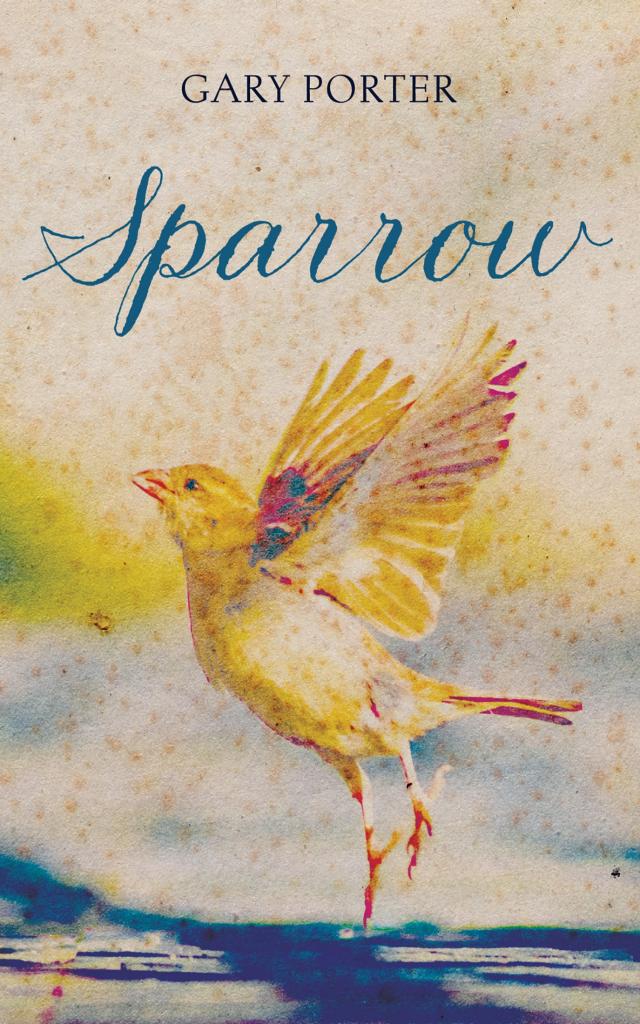
Sparrow
Gary Porter
Sparrow
Copyright © 2023 Gary Porter. All rights reserved. Except for brief quotations in critical publications or reviews, no part of this book may be reproduced in any manner without prior written permission from the publisher. Write: Permissions, Wipf and Stock Publishers, 199 W. 8th Ave., Suite 3, Eugene, OR 97401.
Resource Publications
An Imprint of Wipf and Stock Publishers
199 W. 8th Ave., Suite 3
Eugene, OR 97401
www.wipfandstock.com
paperback isbn: 978-1-6667-7705-5
hardcover isbn: 978-1-6667-7706-2
ebook isbn: 978-1-6667-7707-9
06/23/23
Table of Contents
Title Page
Acknowledgements
Chapter 1
Chapter 2
Chapter 3
Chapter 4
Chapter 5
Chapter 6
For my family
His eye is on the sparrow
And I know he watches me.
—Civilla Durfee Martin
Acknowledgements
I would like to thank everyone from Wipf and Stock Publishers who believed in me and trusted me and worked with me to bring this book into the world.
Enormous thanks to my friends and colleagues who were excited for me and who took precious time out of their busy lives to read this story and help me shape it into something far more loving and more thoughtful than I ever would have been able to do on my own, especially Paul Thompson, Aaron Gourlie, and Dr. Sally Mounts.
I owe an immense debt of gratitude to all the courageous men and women in the recovery community. This book is a tribute to their strength and humility.
Thank you to my parents who are the model of love and generosity, who never stop giving out of the depths of their hearts. They are truly a force for good in this world.
Thank you to my beautiful wife, Krista, and our son, Noah, for being the inspiration for everything I do and the source of every good thing in my life.
Chapter 1
Pastor Judah Greeves lifted his tired eyes from the pulpit, worn smooth under his thumbs where he’d gripped it for decades. He looked up at the dim light through the stained-glass windows and blinked. The flickering light in the rafters started him dreaming again, but he knew she wasn’t really there. She was gone.
A single bead of sweat popped on his forehead and crept along the lines of his face, and he felt it on his skin like a fingernail tracing a slow path around his eye. Where did it come from? This wayward drop of water that was part of him but also somehow separate. Why did it exist at all in this world of suffering and death? What was the point of any of this calamity here on earth? It made no kind of sense. His head fell back in a sudden blind rage against God for the absurdity of it all—for the simple madness of creation. He wanted to cry out in the wilderness like the ancient Israelites in captivity. To curse God and die like Job’s wife who had no name. He drew in a slow, aching breath and smelled a century of dust hanging in the air between him and God.
Creaking pews echoed off the walls as the whole congregation shifted at once in their seats. He felt their eyes burning him, and he realized he had to say something. Anything. He opened his mouth to speak, but no words came out. Because ye speak this word, behold, I will make my words in thy mouth fire, and this people wood, and it shall devour them. But he had no words. And no fire.
He shifted his gaze to his wife, Esther, in the front row with dull, empty eyes. There was nothing encouraging there for him. And after all these years, there was nothing left in those eyes he could understand.
Again, the light in the rafters flickered. And he saw fireflies escape a mason jar and drift up into the stars. A single tear emerged over his eyelid and blurred the ink on his King James Bible. When he looked up, he saw her bright as a sunrise—flickering in the light. Her smile like light flicking off a knife blade. Her eyes shining in the twilight. Was she really there? He reached for her with bony fingers, bent and gnarled from arthritis. That white dress she wore every Sunday when she was eleven. The crimson scar on her arm when she fell in the neighbor’s barn. Her laugh like a creek bubbling over the rocks.
He blinked, and she was gone. A shiver down his spine. The light flickered once more and died. He noticed the stitch in the sleeve of his suit where Esther had patched it with what used to be love. Finally starting to unravel. Head down, shoulders bowed, without a word, Pastor Greeves loped down the steps to join his wife in the front pew. His feet were heavy but made no sound like they somehow vanished with every step.
Awkwardly, the congregation of 16 stood in their Sunday best for the closing hymn, His Eye Is On the Sparrow—like always. A song with only voices. Their pianist passed away years ago. But they sang in harmonies learned from decades, passed down from a generation. The melody nearly forgotten like a ghost hung in the rafters. And Pastor Greeves sang the loudest.
His wife, Esther, shaking, had to sit. The familiar sanctuary blurred through her tears until it almost looked like some other place. Like the blown-glass window over the kitchen sink back home when it rains—where she could see their garden sprawled out to the tree line, teeming with life. And she thought of the cereal bowl from Judah’s breakfast she’d washed that morning and the sound of his spoon digging for the last few flakes. The same sound that echoed back through time when her daughter ate breakfast in that same creaking chair.
Her damp handkerchief fluttered to the floor. She glanced around the sanctuary. They were all crying. Same thing every Sunday. Same damn thing. She couldn’t figure why all these old souls still came back every Sunday to torture themselves. Judah was a shade of the minister he’d once been. They could all see it. She couldn’t figure why they all didn’t go to The Living Waters Assembly Church across town like the rest of them. Why did anybody do anything? She had no idea.
She looked up in the rafters when she heard a flutter and glimpsed a bird dart between wood beams. Bad omen, she thought. Her mom had believed all those old myths and symbols. God rest her soul. She used to say, “A bird in the house means a death within three days.” They had a bird in the house once when Esther was nine, maybe ten. Her mom chased it out with a broom, screaming at the top of her lungs and waving her broom around the kitchen like a mad woman. The hanging pots and pans clanged and rattled. Nobody died then, not that Esther could remember, but her dad came home that night after a week-long bender, and that was a kind of death for the whole family.
When the service ended, Judah pulled the old ladder out of the boiler room and climbed up into the rafters to change the light bulb while Esther waited in the truck. He shimmied out on a rafter and gazed down like a bird. And there she was. His daughter. A flash. Right where she’d stand when she was a girl, tying the knot he’d taught her around the new bulb for him to pull it up. He had to catch himself on a cross beam. His tears dripped between fingers. “Just the devil,” he said out loud. “The devil playing tricks.” He didn’t know if he even believed in the devil anymore. It was just maybe a waking dream. “The king of lies,” he shouted.
He cranked the window down in the truck and smelled the pines drifting in off the mountains. And the wind tossed Esther’s hair. “Lot to do today,” he told her. He looked down at the spiderwebbed photo of his daughter when she was ten. Her wild blonde hair. That defiant, determined look in her eyes. That look he would never forget. Not for all of eternity with the hosts of heaven. The fog tore apart around their truck like a spirit disappearing into the sky.
“My heart just keeps breaking every day, Esther,” he said. His hand shook on the wheel. He felt her hand slide over his, and it didn’t make it any easier. Her wedding ring caught the sun and blinded him a moment. He swallowed a dry, scratchy nothing.
“There was a bird,” Esther told him.
“What?”
“In the sanctuary. A bird flittin’ up in the rafters.” She looked over at him. “Ain’t no good sign.”
“The whole of creation’s a bad sign, Esther.”
This was just Judah’s cross to bear, he told himself. Over and over. Just my cross to bear. God gives one to each of us. What makes us human. He pulled a 10-penny nail from between his lips and hammered it into the trellis for his blackberry bush. He wound electrical tape around the blackberry cordon to hold it in place for the winter. So much work for an old man. He’d done it all the hard way. With shovels and garden forks and hand tools. Double-digging, building raised beds, planting no till gardens. Building hoop houses by hand for the winter. He always thought he’d have a son or daughter to help him when he got old.
And Sparrow was a worker. You could never fault her for that. Skinny but tough. Worked twice as hard as any boy. And she liked the work too, didn’t she? She was happy. Wasn’t she?
He cracked his hammer against a rock. Sparks flew like the dawn of creation. He cracked it again and again until splinters of rock cracked off, spraying in the grass. A drop of sweat. Is not my word like a hammer, saith the Lord; that breaketh the rock in pieces? He cracked it again. Not knowing why. Why he was still alive, he’d never understand. A blackout of rage.
He came to in the grass, smelling the damp earth and the lavender he’d planted for pollinators. He sat up and sniffed the air. It was going to rain. He could smell it.
He thought all the anger had already spilled out of him like a broken bottle and all that w as left were just worthless pieces. But he was wrong. There was still a red, hot streak of rage, creeping in through the cracks, keeping his old bones from flying apart.
He got up and stumbled over the cobblestones between garden rows. He’d carried those rocks up from the river over time in the bed of his truck. He remembered when the garden was beautiful, when it made him happy and gave him a kind of purpose. Now, it was just a burden. He couldn’t keep up with it anymore. Last week, he found deer droppings in his cucumber patch and half his cucumbers gone. They had gotten in through a busted section of fence that he didn’t have the time or the energy to fix. He was too old and too broke down of a man to tend this beautiful patch of earth.
He crawled into bed beside Esther while the rain hit the windows. It was a peaceful rain, but his whole body ached, and sleep kept slipping away. For hours, he stared at shadows tangling on the ceiling and listened to Esther breathe. He tried to look at his hand in the dark. It was shaking. And that was God, he thought. A trembling hand you’ll never see in the dark.
The phone rang. He didn’t hear it. He was still fixing his eyes in the dark. It rang again. That’s the devil, he thought. A ringing phone.
The phone rang. Esther sat up quick in bed like rising from her grave. She slid into her slippers and ran for the phone on the dresser.
“Hello?” Her voice was dry and cracked. She cleared her throat.
“Is this Mrs. Greeves?”
“Yes. This is she,’’ she said.
“Are you Sparrow’s Mom?”
Her hand rose to her mouth. She trembled a second and felt the tears coming in her throat. “Yes,” she said, but it came out a gasp. Six years. Six years waiting for this call. A call to give her hope or closure or something. She needed something. Anything but this feeling she’d had for six years.
“I’m a friend of Sparrow’s.”
“Judah,” she hollered. A voice like a frog’s croak. “Judah!” She changed her grip on the phone. “Is she ok?”
“I’m sorry, Mrs. Greeves.”
“What?”
“I’m sorry. She died.”
“What? What? Judah!” The phone clattered. She hit the floor in her nightgown. Her hair spilled over the hardwood.
“Hello?” Judah Greeves picked up the phone. “Who is this?”
“Mr. Greeves?”
“Yes.”
“I’m sorry, sir. Sparrow’s dead.”
He could hear the young man swallow over the phone. “Who are you,” he asked.
“I’m sorry. She’s at Blessed Heart Hospital in Brier Bend, Minnesota. It was an overdose.” He hung up.
The word of God is quick, and powerful, and sharper than any sword, piercing, even rending asunder the soul and spirit, and the joints and marrow.
A snake crawled up out of Judah’s gut and vomited on the floor. He knelt as if in prayer. The phone started beeping. His heartbeat thumped behind his ears. How was he even still alive if his girl was dead. It was impossible.
Chapter 2
Esther peeked her head into Sparrow’s old room. The door creaked open. The hinges hadn’t moved in years. The room looked exactly like it did the day she left—the bed still unmade, her clothes still in piles on the floor. That weird poster for some rock band still up over her bed. The room even still smelled like Sparrow’s organic shampoo they had to drive all the way into Ninevah Hills to get every couple months. Nineteen dollars a bottle! When they couldn’t afford meat for Sunday night dinner and had to eat tuna fish three days a week, Judah was traipsing her off half-way to Yeden and back, spending a small fortune on soap.
Why did she still resent that so much? Why would she even think of that now of all times? The clock over the desk ticked and ticked. The radiator kicked on. The wind howled, and Esther looked over to the picture window by the bed, but it was too dark to see out.
Early the next morning, when the sun was just peeking over the hills, Judah and Esther packed up the old Ford F-150. Esther wanted to say the old truck wasn’t going to make it. She wanted to say something mean and hurtful, but she couldn’t say anything at all. Her throat was hollow—a deep, echoing well crawling with spiders. And she was somehow trapped in the mud at the bottom, gazing up out at the stars.
With the window down, wind slapped hair in her face, but she couldn’t move her hands to fix it. They were lead weights. She wanted to tell Judah to slow down, but she couldn’t. And if she did, it would be a raspy, shattering howl that would cave in the earth. Sunlight spilled through the wall of pines. She had to close her eyes. And just listen to the tires against the road.
Judah couldn’t remember when he’d realized the infinite sadness of the Old Testament. The theme of it all seemed to be the epic failure of mankind. Made him wish he’d never been born to tell you the truth. Sometimes, at night, he’d pray that the earth would just crash into the sun and burn everything to dust. But he always immediately felt guilty and prayed again to cancel that first prayer.
They drove past the church. Their church. Bethel Hollow Bible Chapel. Tiny, old, brick church falling down. Couldn’t afford to do anything about it. Nobody had any money around here no more.
And he thought of Sparrow, alone, taking her last breath, staring up at a white ceiling and bright lights in some strange place with strange people gaping at her. So scared. And he wasn’t there. He couldn’t imagine it, couldn’t fathom it. It couldn’t be true. Not there to hold her. To tell her he loved her every day and that she brought beauty and love and purpose into a miserable life. Not there to pray and ask God to protect her when she goes off where he can’t follow. Not happening. God wouldn’t let that happen. If there was really a God, He would stop it. He would breathe life back into her. He would unwind time and bring her back. He would part the Earth like the Red Sea and keep his Sparrow from leaving.
Esther fell asleep, with her forehead pressed awkwardly against the car window, dreaming of Sparrow. Things she’d forgot. That damn goat. Sparrow named it Moxie and saved it from a black bear when it was just a kid and showed it more love than any of God’s creatures has a right to. And that time Sparrow was asking for the key to the shed, so she could get out her Daddy’s knife and play with it. She was about seven. Esther didn’t want her to play with the knife, didn’t like that Judah let her. So she said no, but Sparrow kept asking and whining. So she did something that would have made her daughter light up just a few years earlier. She held out her hand and slowly opened her fingers to reveal . . . an empty palm. A trick of imagination. A magic key that could unlock the whole garden. But Sparrow slapped her hand and ran away, crying her little head off.
And how could she have possibly forgotten the Sunday afternoon backyard barbeque at the Gazy’s place over in Bethel Crossing and how Sparrow got drunk on whiskey the Gazy boy stole from the root cellar, and they found her in the creek, dress torn and muddy, half naked? She was twelve. How could she have let herself forget even a single moment? At the end of her dream, Sparrow was falling. Falling from nothing, through nothing, and into nothing. Just falling, hair flailing. Icy blue eyes, gaping.
The truck pulled in a gravel lot, rocks kicking up in the undercarriage. They pulled into a roadside diner for lunch.
They never blamed each other for how Sparrow turned out. They hardly talked about her at all after she left. It was just one of those things that happened, and there was never any clear reason why. “There wasn’t a single thing you could’ve done to love that child any better,” Liota Davis had told them one Sunday after church. “God is gonna work all this trouble out for good. You’ll see,” she told them.
“What now, Liota,” Pastor Greeves wanted to say as he buttered his pancakes. “What now? Our little girl is dead. And God doesn’t even care. What now?” But he didn’t say it. He just kept on buttering his pancakes.
Suddenly, his hand shook, and he dropped the knife. “Did we screw it up,” he asked his wife through a sudden gush of tears. “Did we not love her enough?”






