Covert one 3 the paris.., p.1
Covert One 3 - The Paris Option, page 1
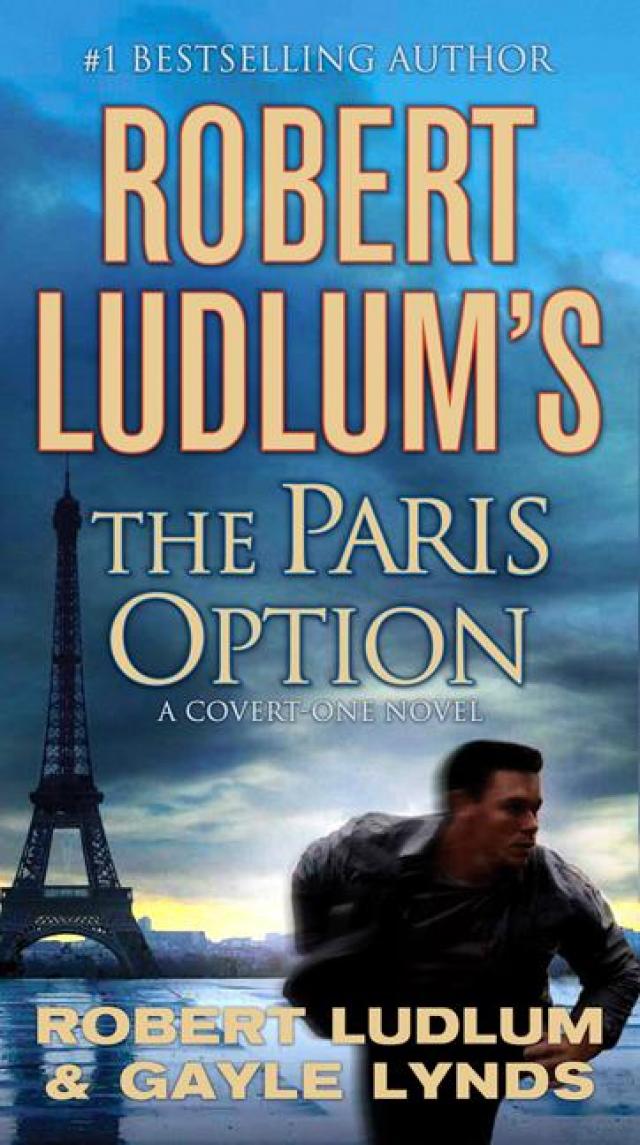


Covert One 3 - The Paris Option
Covert One 3 - The Paris Option
Covert One 3 - The Paris Option
Paris, France Sunday, May 4
The first warm winds of spring gusted along Paris’s narrow back streets and broad boulevards, calling winter-weary residents out into the night. They thronged the sidewalks, strolling, linking arms, filling the chairs around outdoor cafeacute; tables, everywhere smiling and chatting. Even the tourists stopped complaining this was the enchanting Paris promised in their travel guides.
Occupied with their glasses of vin ordinaire under the stars, the spring celebrators on the bustling rue de Vaugirard did not notice the large black Renault van with darkened windows that left the busy street for the boulevard Pasteur. The van circled around the block, down the rue du Docteur Roux, and at last entered the quiet rue des Volontaires, where the only action was of a young couple kissing in a recessed doorway.
The black van rolled to a stop outside L’Institut Pasteur, cut its engine, and turned off its headlights. It remained there, silent, until the young couple, oblivious in their bliss, disappeared inside a building across the street.
The van’s doors clicked open, and four figures emerged clothed completely in black, their faces hidden behind balaclavas. Carrying compact Uzi submachine guns and wearing backpacks, they slipped through the night, almost invisible. A figure materialized from the shadows of the Pasteur Institute and guided them onto the grounds, while the street behind them remained quiet, deserted.
Out on the rue de Vaugirard, a saxophonist had begun to play, his music throaty and mellow. The night breeze carried the music, the laughter, and the scent of spring flowers in through the open windows of the multitude of buildings at the Pasteur. The famed research center was home to more than twenty-five hundred scientists, technicians, students, and administrators, and many still labored into the night.
The intruders had not expected so much activity. On high alert, they avoided the paths, listening, watching the windows and grounds, staying close to trees and structures as the sounds of the springtime gaiety from the rue de Vaugirard increased.
But in his laboratory, all outside activity was lost on Dr. Emile Chambord, who sat working alone at his computer keyboard on the otherwise unoccupied second floor of his building. His lab was large, as befitted one of the institute’s most distinguished researchers. It boasted several prize pieces of equipment, including a robotic gene-chip reader and a scanning-tunneling microscope, which measured and moved individual atoms. But more personal and far more critical to him tonight were the files near his left elbow and, on his other side, a spiral bound notebook, which was open to the page on which he was meticulously recording data.
His fingers paused impatiently on the keyboard, which was connected to an odd-looking apparatus that appeared to have more in common with an octopus than with IBM or Compaq. Its nerve center was contained in a temperature-controlled glass tray, and through its sides, one could see silver-blue gel packs immersed like translucent eggs in a jellied, foamlike substance. Ultrathin tubing connected the gel packs to one another, while atop them sat a lid. Where it interfaced with the gel packs was a coated metallic plate. Above it all stood an iMac-sized machine with a complicated control panel on which lights blinked like impulsive little eyes. From this machine, more tubing sprouted, feeding into the pack array, while wires and cables connected both the tray and the machine to the keyboard, a monitor, a printer, and assorted other electronic devices.
Dr. Chambord keyboarded in commands, watched the monitor, read the dials on the iMac-sized machine, and continually checked the temperature of the gel packs in the tray. He recorded data in his notebook as he worked, until he suddenly sat back and studied the entire array. Finally he gave an abrupt nod and typed a paragraph of what appeared to be gibberishletters, numbers, and symbolsand activated a timer.
His foot tapped nervously, and his fingers drummed the lab bench. But in precisely twelve seconds, the printer came to life and spit out a sheet of paper. Controlling his excitement, he stopped the timer and made a note. At last he allowed himself to snatch up the printout.
As he read, he smiled. “Mais oui.”
Dr. Chambord took a deep breath and typed small clusters of commands. Sequences appeared on his screen so fast that his fingers could not keep up. He muttered inaudibly as he worked. Moments later, he tensed, leaned closer to the monitor, and whispered in French, “hellip;one morehellip;onehellip;morehellip;there!”
He laughed aloud, triumphant, and turned to look at the clock on the wall. It read 9:55 p.m. He recorded the time and stood up.
His pale face glowing, he stuffed his files and notebook into a battered briefcase and took his coat from the old-fashioned Empire wardrobe near the door. As he put on his hat, he glanced again at the clock and returned to his contraption. Still standing, he keyboarded another short series of commands, watched the screen for a time, and finally shut everything down. He walked briskly to the door, opened it onto the corridor, and observed that it was dim and deserted. For a moment, he had a sense of foreboding.
Then he shook it off. Non, he reminded himself: This was a moment to be savored, a great achievement. Smiling broadly, he stepped into the shadowy hall. Before he could close the door, four black-clothed figures surrounded him.
Thirty minutes later, the wiry leader of the intruders stood watch as his three companions finished loading the black van on the rue des Volontaires. As soon as the side door closed, he appraised the quiet street once more and hopped into the passenger seat. He nodded to the driver, and the van glided away toward the crowded rue de Vaugirard, where it disappeared in traffic.
The lighthearted revelry on the sidewalks and in the cafeacute;s and tabacs continued. More street musicians arrived, and the vin ordinaire flowed like the Seine, Then, without warning, the building that housed Dr. Chambord’s laboratory on the legendary Pasteur campus exploded in a rolling sheet of fire. The earth shook as flames seemed to burst from every window and combust up toward the black night sky in a red-and-yellow eruption of terrible heat visible for miles around. As bricks, sparks, glass, and ash rained down, the throngs on the surrounding streets screamed in terror and ran for shelter.
PART ONE
Covert One 3 - The Paris Option
Chapter One
Diego Garcia Island, Indian Ocean
At 0654 hours at the vital U.S. Army, Air Force, and Naval installation on Diego Garcia, the officer commanding the shift at the control tower was gazing out the windows as the morning sun illuminated the warm blue waters of Emerald Bay on the lagoon side of the U-shaped atoll and wishing he were off duty. His eyes blinked slowly, and his mind wandered.
The U.S. Navy Support Facility, the host command for this strategically located, operationally invaluable base, kept all of them busy with its support of sea, air, and surface flight operations. The payback was the island itself, a remote place of sweeping beauty, where the easy rhythms of routine duty lulled ambition.
He was seriously contemplating a long swim the instant he was off duty when, one minute later, at 0655 hours, the control tower lost contact with the base’s entire airborne fleet of B-1B, B-52, AWACS, P-3 Orion, and U-2 aircraft, on a variety of missions that included hot-button reconnaissance and antisubmarine and surveillance support.
The tropical lagoon vanished from his mind. He bawled orders, pushed a technician from one of the consoles, and started diagnostics. Everyone’s attention was riveted on the dials, readouts, and screens as they battled to regain contact.
Nothing helped. At 0658, in a controlled panic, he alerted the base’s commanding officer.
At 0659, the commanding officer informed the Pentagon.
Then, oddly, inexplicably, at 0700, five minutes after they had mysteriously disappeared, all communications with the aircraft returned at the precise same second.
Fort Collins, Colorado Monday, May 5
As the sun rose over the vast prairie to the east, the rustic Foothills Campus of Colorado State University glowed with golden light. Here in a state-of-the-art laboratory in a nondescript building, Jonathan (“Jon”) Smith, M.D., peered into a binocular microscope and gently moved a finely drawn glass needle into position. He placed an imperceptible drop of fluid onto a flat disk so small that it was no larger than the head of a pin. Under the high-resolution microscope, the plate bore a striking and seemingly impossibleresemblance to a circuit board.
Smith made an adjustment, bringing the image more clearly into focus. “Good,” he muttered, and smiled. “There’s hope.”
An expert in virology and molecular biology, Smith was also an army medical officerin fact, a lieutenant coloneltemporarily stationed here amid the towering pines and rolling foothills of Colorado at this Centers for Disease Control (CDC) facility. On unofficial loan from the U.S. Army Medical Research Institute of Infectious Diseases (USAMRIID), he was assigned basic research into evolving viruses.
Except that viruses had nothing to do with the delicate work he was watching through the microscope this dawn. USAMRIID was the army’s foremost military medical research facility, while the CDC was its highly touted civilian counterpart. Usually they were vigorous rivals. But not here, not now, and the work being done in this laboratory had only a peripheral connection to medicine.
Smith was part of a little-known CDC-USAMRIID research team in a worldwide race to create the world’s first molecularor DNAcomputer, therefore forging an un
If successful, their brand-new DNA circuits could be reconfigured many times, taking the joint team one step closer to rendering silicon, the key ingredient in the wiring of current computer circuit boards, obsolete. Which was just as well. The computer industry was near the limits of silicon technology anyway, while biological compounds offered a logicalalthough difficultnext step. When DNA computers could be made workable, they would be vastly more powerful than the general public could conceive, which was where the army’s, and USAMRIID’s, interests came in.
Smith was fascinated by the research, and as soon as he had heard rumors of the secret joint CDC-USAMRIID project, he had arranged to be invited aboard, eagerly throwing himself into this technological competition where the future might be only an atom away.
“Hey, Jon.” Larry Schulenberg, another of the project’s top cell biologists, rolled into the empty laboratory in his wheelchair. “Did you hear about the Pasteur?”
Smith looked up from his microscope. “Hell, I didn’t even hear you open the door.” Then he noticed Larry’s somber face. “The Pasteur,” he repeated. “Why? What’s happened?” Like USAMRIID and the CDC, the Pasteur Institute was a world-class research complex.
In his fifties, Schulenberg was a tan, energetic man with a shaved head, one small diamond earring, and shoulders that were thickly muscled from years of using crutches. His voice was grim. “Some kind of explosion. It’s bad. People were killed.” He peeled a sheet from the stack of printouts on his lap.
Jon grabbed the paper. “My God. How did it happen? A lab accident?”
“The French police don’t think so. Maybe a bomb. They’re checking out former employees.” Larry wheeled his chair around and headed back to the door. “Figured you’d want to know. Jim Thrane at Porton Down e-mailed me, so I downloaded the story. I’ve got to go see who else is here. Everyone will want to know.”
“Thanks.” As the door closed, Smith read quickly. Then, his stomach sinking, he reread …
Labs at Pasteur Institute Destroyed
ParisA massive explosion killed at least 12 people and shattered a three-story building housing offices and laboratories at the venerable Pasteur Institute at 10:52 p.m. here last night. Four survivors in critical condition were found. The search continues in the rubble for other victims.
Fire investigators say they have found evidence of explosives. No person or group has claimed responsibility. The probe is continuing, including checking into recently released employees.
The identified survivors include Martin Zellerbach, Ph.D., a computer scientist from the United States, who suffered head injurieshellip;.
Smith’s heart seemed to stop. Martin Zellerbach, Ph.D., a computer scientist from the United States, who suffered head injuries. Marty? His old friend’s face flashed into Jon’s mind as he gripped the printout. The crooked smile, the intense green eyes that could twinkle one moment and skitter off, lost in thought or perhaps outer space, the next. A small, rotund man who walked awkwardly, as if he had never really learned how to move his legs, Marty had Asperger’s Syndrome, a rare disorder at the less severe end of the autism spectrum. His symptoms included consuming obsessions, high intelligence, crippling lack of social and communications skills, and an outstanding talent in one particular areamathematics and electronics. He was, in fact, a computer genius.
A worried ache settled in Smith’s throat. Head injuries. How badly was Marty hurt? The news story did not say. Smith pulled out his cell phone, which had special scrambler capabilities, and dialed Washington.
He and Marty had grown up together in Iowa, where he had protected Marty from the taunts of fellow students and even a few teachers who had a hard time believing anyone so smart was not being intentionally rude and a troublemaker. Marty’s Asperger’s was diagnosed when he was older and at last he was given the medication that helped him function with both feet firmly attached to the planet. Still, Marty hated taking meds and had designed his life so he could avoid them as often as possible. He did not leave his cozy Washington, D.C., bungalow for years at a time. There he was safe with the cutting-edge computers and the software he was always designing, and his mind and creativity could soar, unfettered. Businessmen, academicians, and scientists from around the globe went there to consult him, but never in person, only electronically.
So what was the shy computer wizard doing in Paris?
The last time Marty consented to leave was eighteen months ago, and it was far from gentle persuasion that convinced him. It was a hail of bullets and the beginning of the near catastrophe of the Hades virus that had caused the death of Smith’s fianceacute;e, Sophia Russell.
The phone at Smith’s ear began to ring in distant Washington, D.C., and at the same time he heard what sounded like a cell phone ringing just outside his laboratory door. He had an eerie sense …
“Hello?” It was the voice of Nathaniel Frederick (“Fred”) Klein.
Smith turned abruptly and stared at his door. “Come in, Fred.”
The chief of the extremely secret Covert-One intelligence and counterintelligence troubleshooting organization stepped into the laboratory, quiet as a ghost, still holding his cell phone. “I should’ve guessed you would’ve heard and called me.” He turned off his phone.
“About Mart? Yes, I just read about the Pasteur. What do you know, and what are you doing here?”
Without answering, Klein marched past the gleaming test tubes and equipment that crowded the line of lab benches, which soon would be occupied by other CDC-USAMRIID researchers and assistants. He stopped at Smith’s bench, lifted his left hip, and sat on the edge of the stone top, arms crossed, face grim. Around six feet tall, he was dressed as usual in one of his rumpled suits, this one brown. His skin was pale; it rarely saw the sun for any length of time. The great outdoors was not where Fred Klein operated. With his receding hairline, wire-rimmed glasses, and high, intelligent forehead, he could be anything from book publisher to counterfeiter.
He contemplated Smith, and his voice was compassionate as he said, “Your friend’s alive, but he’s in a coma. I won’t lie to you, Colonel. The doctors are worried.”
For Smith, the dark pain of Sophia’s death could still weigh heavily on him, and Marty’s injury was bringing it all back. But Sophia was gone, and what mattered now was Marty.
“What the hell was he doing at the Pasteur?”
Klein took his pipe from his pocket and brought out his tobacco pouch. “Yes, we wondered about that, too.”
Smith started to speak againhellip;then hesitated. Invisible to the public and to any part of the government except the White House, Covert-One worked totally outside the official military-intelligence bureaucracy and far from the scrutiny of Congress. Its shadowy chief never appeared unless something earthshaking had happened or might happen. Covert-One had no formal organization or bureaucracy, no real headquarters, and no official operatives. Instead, it was loosely composed of professional experts in many fields, all with clandestine experience, most with military backgrounds, and all essentially unencumberedwithout family, home ties, or obligations, either temporary or permanent.
When called upon, Smith was one of those elite operatives.
“You’re not here because of Marty,” Smith decided. “It’s the Pasteur. Something’s going on. What?”
“Let’s take a walk outside.” Klein pushed his glasses up onto his forehead and tamped tobacco into his pipe.
“You can’t light that here,” Smith told him. “DNA can be contaminated by airborne particles.”
Klein sighed. “Just one more reason to go outdoors.”
Fred Kleinand Covert-Onetrusted no one and nothing, took nothing for granted. Even a laboratory that officially did not exist could be bugged, which, Smith knew, was the real reason Klein wanted to leave. He followed the intelligence master out into the hall and locked his door. Side by side, they made their way downstairs, past dark labs and offices that showed only occasional light. The building was silent except for the breathy hum of the giant ventilation system.