Stars of albion v1 0, p.1
Stars of Albion (v1.0), page 1
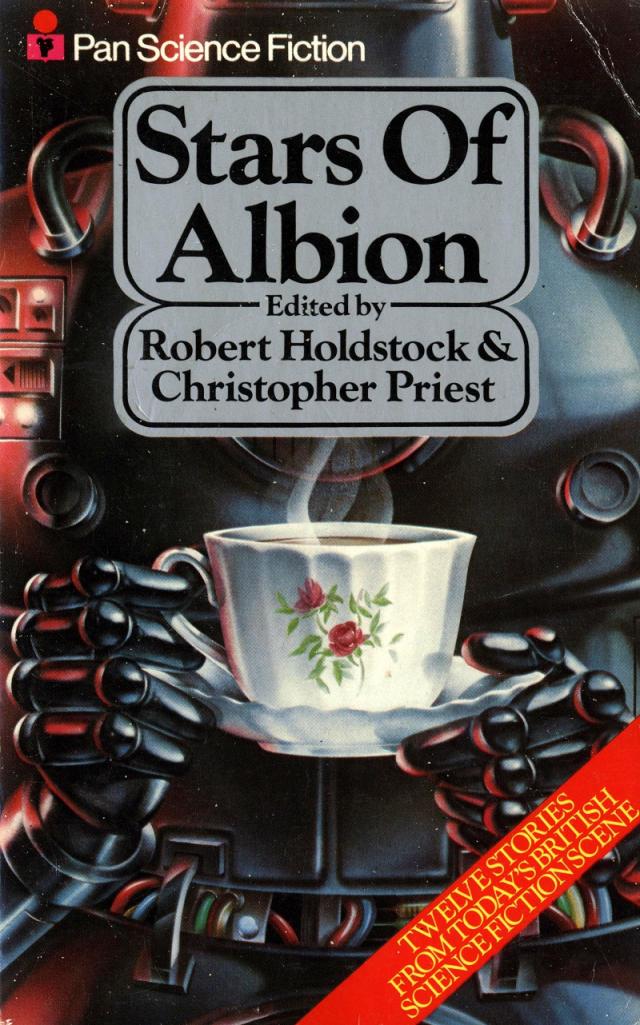


Stars of Albion
Robert Holdstock was born in 1948 in Kent. He was educated at Gillingham Grammar School and went on to read Applied Zoology and Parasitology at the University College of North Wales, Bangor.
Whilst a student he became involved with the world of SF, attending conventions and meeting other enthusiasts. His first story was published in 1968 in New Worlds; since then he has had work in New Writings in SF, Science Fiction Monthly, Stopwatch, Andromeda and Vortex.
In 1970 he moved to London to take up research in Medical Zoology, but turned freelance writer in 1975. He married in 1973 and now lives in Hertfordshire.
His novels Eye Among the Blind and Earthwind are both published in Pan.
Christopher Priest was bom in 1943 in Cheshire, and spent his childhood in the north of England. After leaving school he moved to London, where he spent the next nine years discovering that he and the accountancy profession were not made for each other. He became a full-time writer in 1968, and since then has written five novels, of which A Dream of Wessex, Fugue for a Darkening Island, Indoctrinaire and Inverted World are published in Pan.
Stars of Albion
edited by Robert Holdstock
and Christopher Priest
Pan Books London and Sydney
This collection first published 1979 by Pan Books Ltd,
Cavaye Place, London SW10 9PG,
Collection © Robert Holdstock and Christopher Priest 1979
Introduction © Robert Holdstock 1979
Afterword © Christopher Priest 1979
SBN 0 330 25872 9
Printed and bound in Great Britain by Hazell Watson & Viney Ltd, Aylesbury, Bucks
This book is sold subject to the condition that it shall not, by way of trade or otherwise, be lent, re-sold, hired out or otherwise circulated without the publisher’s prior consent in any form of binding or cover other than that in which it is published and without a similar condition including this condition being imposed on the subsequent purchaser
‘Shush! ’ said Joan.
‘What do you mean: “shush”?’
She nudged him, and nodded towards the entrance port. Dale had just left the airlock; in one hand he carried a trowel, and in the other, a rod with a flag attached to it. The rest watched while he dug a small hole, planted his pole, and stamped the red sand back about its base. He stood back. The Union Jack unfolded gently in the light Martian breeze. Dale saluted.
‘In the name of Her Majesty Queen Elizabeth the Second of England, I proclaim this land a part of the British Commonwealth of Nations. In her name, and in the name of all the peoples of the Commonwealth, I honour the brave men who gave their lives that this thing might be done. To their memory let it be dedicated, to their glory let it thrive. They gave us this land, not in bloodshed, but with their life’s blood. May we prove worthy of their trust.’
In the silence which followed an air of constraint fell over the party.
John Wyndham, Stowaway to Mars
Acknowledgements.
The passage from Stowaway to Mars by John Wyndham © the Executors of John Beynon Harris 1935; reprinted by kind permission of David Higham Associates Ltd. Stowaway to Mars was first published in 1935 (as Planet Plane) by George Newnes Ltd; this extract is taken from the 1974 edition by Michael Joseph Ltd.
‘Sober Noises of Morning in a Marginal Land’ by Brian W. Aldiss © Brian W. Aldiss 1971; first published in The Best Science Fiction Stories of Brian W. Aldiss (revised edition), Faber & Faber Ltd, 1971; reprinted by permission of the author and his agent.
‘A Place and a Time to Die’ by J. G. Ballard © J. G. Ballard 1969; first published in New Worlds, 1969; reprinted by permission of the author and his agent.
‘The Giaconda Caper' by Bob Shaw © Bob Shaw 1976; first published in Cosmic Kaleidoscope, Victor Gollancz Ltd, 1976; reprinted by permission of the author.
‘The Vitanuls' by John Brunner © Mercury Press Inc 1967,
Brunner Fact & Fiction Ltd 1972; first published in The Magazine of Fantasy & Science Fiction, 1967; this version first published in From This Day Forward, Doubleday and Co, Inc, 1972; reprinted by permission of the author.
‘Whores’ by Christopher Priest © Robert Silverberg 1978, © Christopher Priest 1979; first published in New Dimensions 8, Harper & Row Publishers Inc, 1978; this version first published in An Infinite Summer, Faber & Faber Ltd, 1979; reprinted by permission of the author.
‘Warlord of Earth' by David S. Garnett © David S. Garnett 1977, 1978; first published in Science Fiction Story Reader 8t original title ‘Kriegsherr der Erde’; first English language publication in The Magazine of Fantasy & Science Fiction, 1978; reprinted by permission of the author.
‘The Time Beyond Age: A Journey’ by Robert Holdstock © Robert Holdstock 1976; first published in Supernova /, Faber & Faber Ltd, 1976; reprinted by permission of the author.
‘Dormant Soul' by Josephine Saxton © Mercury Press Inc 1968; first published in The Magazine of Fantasy & Science Fiction, 1969; reprinted by permission of the author.
‘The Radius Riders’ by Barrington J. Bayley © Barrington J. Bayley 1962; first published in Science Fiction Adventures, 1962; reprinted by permission of the author.
‘Traveller’s Rest' by David I. Masson © David I. Masson 1965,
1968; first published in New Worlds, 1965; this version first published in The Caltrops of Time, Faber & Faber Ltd, 1968; reprinted by permission of the author, and Faber & Faber Ltd.
‘To the Pump Room with Jane’ by Ian Watson © Ian Watson 1975; first published in New Writings in SF 26, Sidgwick & Jackson Ltd, 1975; reprinted by permission of the author.
‘Weihnachtabend’ by Keith Roberts © Keith Roberts 1972; first published in New Worlds Quarterly 4, Sphere Books Ltd, 1972; reprinted by permission of the author and his agent
Contents
Acknowledgements.
Introduction by Robert Holdstock
Brian W. Aldiss Sober noises of morning in a marginal land
J. G. Ballard A place and a time to die
Bob Shaw The Giaconda Caper
John Brunner The Vitanuls
Christopher Priest Whores
David S. Garnett Warlord of Earth
Robert Holdstock The time beyond age: A journey
Josephine Saxton Dormant soul
Barrington J. Bayley The radius riders
David I. Masson Traveller’s Rest
Ian Watson To the Pump Room with Jane
Keith Roberts Weihnachtabend
Afterword by Christopher Priest
Introduction
by Robert Holdstock
It is not enough to talk the talk, we must be seen to wave the flag! The Union Jack has not, as yet, dangled limply over the dust plains of Luna, but it has flown above some of the most imaginative and energetic science fiction since well before the start of this century. There have been bad years, certainly, but when Judith Merril compiled a collection of new British sf in 1968 it was a clear demonstration that the imaginative doldrums of the ’40s and ’50s had gone away and that a sparkling and diverse Active force was emerging in Britain - sometimes loosely, sometimes tightly bound up with the science fiction idiom. Stars of Albion, if it claims to be anything other than an anthology of excellent science fiction stories by British writers, is our statement that sf in Britain is still going uphill from the Brave New Words of the nineteen sixties.
In the afterword to this book Chris Priest expands on one of the factors that finally decided us to compile a collection of British sf, the feeling that the focus of interest in sf has so shifted to America that British writers and their work have become something akin to a second league.
The fact is that British science fiction is in a class of its own, following its own individual obsessions, themes and lines of intellectual development. We are not making the claim that British sf is better than the sf of other countries: God forbid. There is a sufficient distance between the English-speaking nations for the literature of those different countries to signify a different cultural attitude, in their approach both to writing and to the value of entertainment - even to the use of the common language.
No, British writers are unique only in being a highly individual group, generally hostile to any commercial pressure to adapt or modify their work to market requirements - the current pulp revival makes this a very real issue - and speaking in cultural accents that are innate to their British perceptions. Within the body of work emerging from the thirty or so fully active British sf writers is a framework of ideas every bit as exciting, as powerful and innovative as the framework of ideas perceptible across the Atlantic; there is a wider span of literary technique, some of us would boldly claim, than in America; there is a great concern for individuality of style; and at times a certain (some would say unwise) wild indulgence. The landscapes of British sf are exotic, alien, but fundamentally internal. Many writers here are concerned with the interplay between neurons rather than aliens; but they see, as indeed do the best writers of any culture, that the ingredients and locations of the Fantastic are exquisitely manipulable symbols for their themes, and also contain such an intrinsic ability to excite the ‘wonder buds’ that it would be madness not to exploit them.
It is not, then, any qualitative difference between British sf and the sf of other countries that has inspired this collection, but rather a feeling of neglect, of wanting to draw specific attention to the British writers. Stars of Albion is a conscious attempt to compile stories that sho
In compiling this collection we have had several concerns centrally at heart, the main being to find the science fiction by our contemporaries that most vividly and excitingly displays the voice and talents of the authors - and by implication, therefore, the voice of British science fiction as a whole. We have tried to counterbalance the familiar writer with the less familiar writer, and, more importantly, the familiar story with the less familiar story; so we are delighted to be able to include both Brian Aldisis’s ambiguous interrogation on the steppes of Kazakhstan, ‘Sober noises of morning in a marginal land’, and J. G. Ballard’s ‘A place and a time to die’. In several cases we have sought the ideal story as a compromise between the author’s best work and his best-known work (not always the same thing). We are conscious that one story, David Masson’s ‘Traveller’s Rest’, has become a ‘classic' in its own time; just as no collection of British sf would be complete without reference to a Union Jack unfurled on Mars, so we felt that none would be complete without this particular story.
Keith Roberts' haunting vision of a post-Nazi England, ‘Weihnachtabend’, is quite likely to become highly influential in its own time; the story is so disturbing, however, so powerful when read with awareness of the current rise of fascism in this country, that there was never any question of this being the Roberts story that we wanted.
And for different reasons we included Dave Garnett’s ‘Warlord of Earth’ and Barry Bayley’s ‘The radius riders’: the Garnett for its sustained impish humour, and the Bayley for the pure energy and inventiveness of one of the best of his extravaganzas. Few British sf writers actively write humour - cerebral decay or the flooding of the English lowlands being much more our cup of tea; but when humorists emerge they are a joy to behold. Elsewhere, in ‘The Vitanuls’, John Brunner bends current reincarnation theory to his own ends, but concerns himself with the totality of distance between Western and Eastern culture with such understatement and perception that the story reflects in its very quiescence the difference in energy levels of the various human spirits.
Josephine Saxton’s ‘Dormant soul’ is concerned with another sort of spirit. Reading your way through Saxton territory is a wonderful and dazzling experience, as no single thing, least of all food, is considered undeserving of a richly textured description - James Blish once suggested that Ms Saxton may have invented a new pornography: food pornography! All facets of Ms Saxton’s bizarre talents are revealed in this story of possession by a bird demon from Sirius 8!
As for the inclusion of ‘Whores’ and ‘The time beyond age’, the compilers of this collection truly agonized about using samples of their own work - for a full minute at least - finally bowing to the eloquent argument: ‘Why the hell not?’ Besides which, ‘Whores’ is possibly one of the most powerful Priest stories I have read, a stark and evocative study of a particularly harrowing sexual obsession.'
Alas, while trying to compile a collection such as Stars of Albion one is constantly aware of the limitations imposed by the economics of publishing; we regret very much, therefore, not being able to include one of Richard Cowper’s elegant novellas, or M. John Harrison’s ‘Running Down’, or some samples of Moorcock and Clarke, or ‘Fidei Defensor’, by bold new writer Mike Rohan. Next time?
Finally, then, we offer you Stars of Albion as an exciting collection of the life, energy and diversity of British sf over the last fifteen years, an energy and diversity that we both feel is continuing apace.
Rob Holdstock
' Besides which, The time beyond age’ is possibly one of the most powerful Holdstock stories I have read, a stark and evocative study of a particularly heartfelt medical obsession. C.P'
Brian W. Aldiss
Sober noises of morning
in a marginal land
At four o’clock in the morning, the Interrogator left me. His assistant unshackled the pinions from my ankles and switched off the two arc-lights, which had been pouring brightness into my face. They dulled, gloomed, died.
The assistant helped me to my feet and guided me out of the room, up the stone stairs into the wide hallway, where the old smell of sulphur lay thick, and up the bare wooden staircase to my room on the first floor. I staggered to my bed as he left, fell upon it.
Précis: In the lizard hours of night, conscious and unconscious gesture are one.
For a long while, I lay where I was, my legs straggling over the side of the bed with my feet touching the floor. My face had been beaten. Its swellings extended the irregular contours of my head to infinity in a contradictory way. One burning cheek was lodged against the high ceiling, while the tender area below my eyelids encompassed a place where there was birdsong. And was there not tender but firm music - Khaldy by a courteous violin - playing in some flooded cavern where my heart beat?
A stretch of time that I thought of as 2n (x - me)2 passed, threshing by my mattress like a wounded snake. Its conclusion was the signal for me to struggle to my feet and go to the window.
I sat in the wicker chair there, holding on to the sill, looking out at the submerged forms of darkness through the pane. The wooden sill was deep-set and worn with age and use, like an old human face. The window had wooden interior shutters nailed back so that they never closed. Their sickly pale blue-green paint was blistered. The window was of two equal parts which had been intended to open outwards. They were nailed closed. There were metal bars outside the window.
The window had weathered changes of season and regime; once it had welcomed guests in a hotel - now it guarded prisoners. Once, visitors came to take the malodorous waters of the spa. Now they drank more bitter medicine.
Précis: Eyes and windows remained sealed with reason.
Perhaps I slept by the window. The Interrogator was not there again, but he had his allies in my psyche who spoke for him when he was away.
'You know what I am holding in my hand?'
‘No.'
‘What does it look like?’
‘Looks like paper.’
‘Then - what is on this paper?’
‘Writing?’
‘Whose writing?’
‘If you let me look, I might have a chance of answering.'Whose writing?’
‘Mine.’
‘It’s your diary for yesterday. You know you are ordered to write a thousand words every day. There are only nine hundred and six words here. Why?’
‘I ran out of words.’
‘We can slow your circadian rhythms again.'
‘No!’
‘Read me what you have written.’
He handed me the page and I stumbled over my shaggy hand-' writing.
‘You remember various things without knowing what it is you remember. Like being reunited with someone you loved. You love. Or not being reunited. Anonymous sort of longing to have her dear embrace. One embrace. Dear one embrace. In the sill it’s all written there’s really nothing to captivity, perhaps I’m freer here than at home by staring at this piece of wood. I have written it before and I can think of my wife, looking out of that other window at her talking to some other man. The baker perhaps it was we paid him once a week. Her legs in the little pale courtyard with green bushes I forget their name. It twined up the side and that was my dear moment of happiness to look at her and see all I had to leave. She in that colossal city maintaining herself. But isn’t it also an empty time or we find ourselves by separation. I mean this is only today but there is another place we all know of where it’s not just today and where these things like separation and punishment and pain don’t belong. A place here nowhere supernatural right on this sill of closure ..